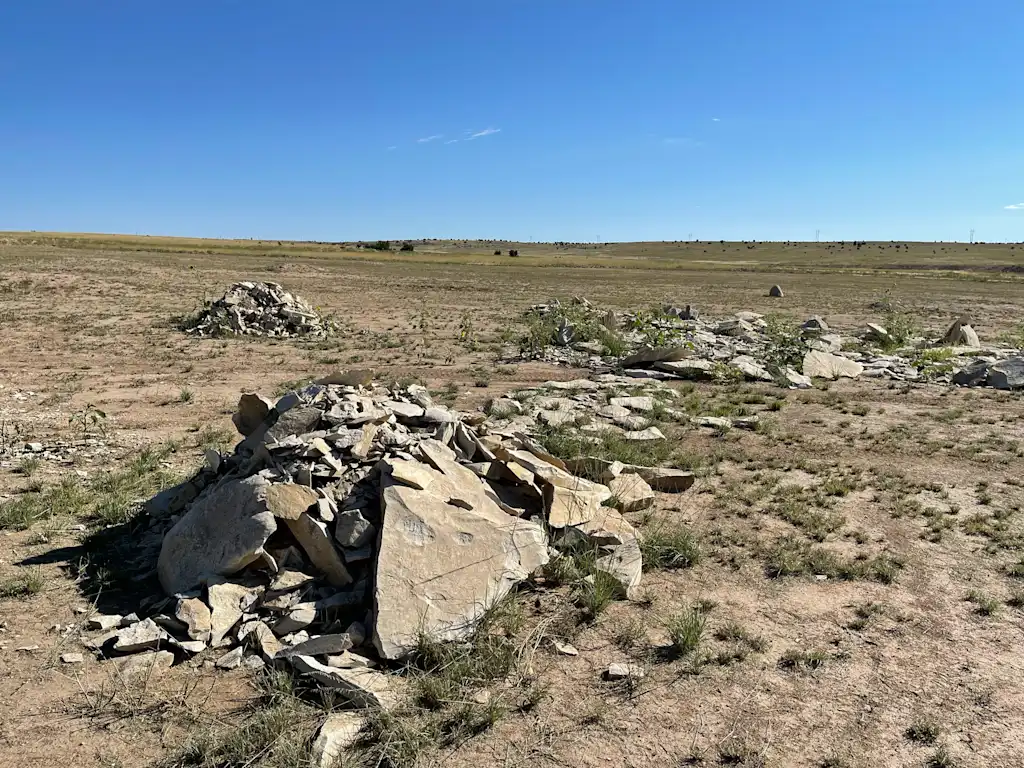
In a Rye, Colorado, cattle pasture now subbing for the moon, an otherworldly vehicle bumps along a scrubby course of furrows and mounds, weaving around rocks and kicking up a fine dust. It’s an open-concept machine dubbed Falcon—a silver solar-powered rectangular frame on wheels, with a partial roof, windowless sides, and a spacious cockpit flanked by monitors and steering controls. An engineer sits in one of its two seats for safety as the vehicle autonomously navigates around obstacles to a location dictated by Mission Control 160 miles away.
Suddenly, a wheel hits a rock, and Falcon halts, relaying real-time feedback to Mission Control. There, an operator revises a command for another attempt, driving home the hurdles in developing novel spacefaring technology.
“We don’t stage any of this for you guys,” laughs Justin Cyrus. “We show you real testing.”
Our play-by-play guide is the 32-year-old CEO and founder of Lunar Outpost, a rising star in the space robotics and mobility field. In less than a decade, the Denver area startup has already operated technology on Mars, landed the first commercial rover on the moon, and lined up another six lunar and cislunar missions with government and commercial partnerships—the most of any private company. Now, it’s vying with two other firms to build NASA’s next-generation lunar terrain vehicle (LTV) to shuttle Artemis V astronauts and experiments in 2030. At stake: a contract worth up to $4.6 billion. NASA is slated to make its decision this month.

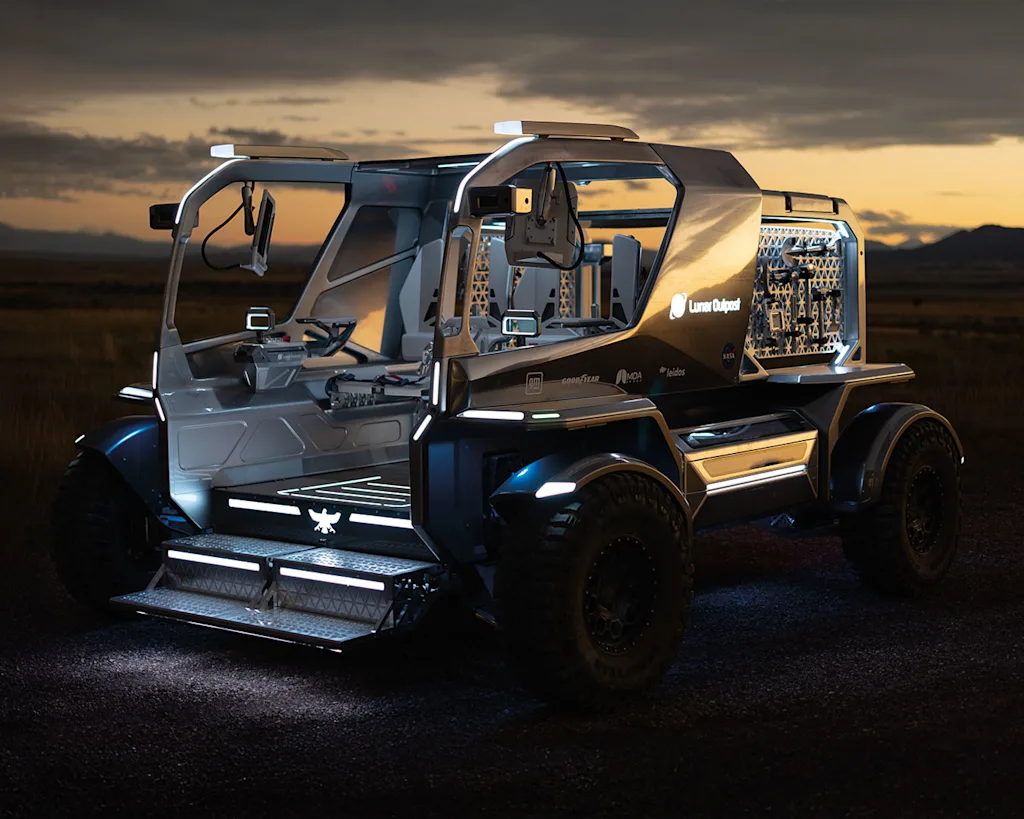
That model—a sleeker upgrade to Falcon, named Eagle, after Apollo 11’s crewed lander—awaits in a barnlike workshop, a short walk down a sloped dirt road where visitors are warned to keep an eye out for snakes. This is not your grandparents’ moon buggy. Eagle reaches speeds up to 25 mph (compared to Apollo’s 11 mph) for emergencies, though astronauts will stick to under 15 mph for safety. It can also climb 25-degree slopes, which engineers test on a nearby shale rock ridge, and carry more than 2.4 tons of cargo. It will operate in four driving modes: manually, assisted autonomy, teleoperated from Earth, and full autonomy with preprogrammed missions. And it’s crafted to run for years in the lunar south pole’s punishing radiation levels, abrasive dust, severe lighting, and temperature extremes ranging from 130 ºF in sunlight to—334 ºF in permanently shaded craters.
This 1,000-acre patch of the Cyrus family ranch seems an unexpected Lunar Vehicle Test Site, as announced by a nearby sign. But the rugged landscape surrounding futuristic machines and a CEO decked out in black jeans and cowboy boots implies a fitting message: the adventurous spirit of the American West vaulting into the space age.
“For the space economy, you need a robotic workforce,” says Cyrus. “So, the idea behind Lunar Outpost—let’s make that robotic workforce for extreme environments—evolved over the years into a robotic workforce on other planetary bodies. We want to be the company that makes outposts on the moon and cities on Mars.”
Eagle in the lunar economy
NASA’s Artemis missions seek to return humans to the moon and establish a sustainable lunar base and economy as a springboard to crewed missions to Mars. As part of it, the space agency last year awarded contracts to Lunar Outpost, Venturi Astrolab in Hawthorne, CA, and Intuitive Machines in Houston to design LTVs to shuttle astronauts, transport equipment, and conduct sample gathering and analysis.
Regardless of NASA’s choice, the Eagle is still headed to the moon. Last year, it secured a commercial agreement with SpaceX to use its Starship to deliver Eagle to the lunar surface, where it can be used commercially when not needed by NASA.
Eagle is a feat of engineering. It boasts a sensor suite of 360-degree stereoscopic cameras, LIDAR, and an electrodynamic dust system (EDS) that clears particulates off solar panels and lenses. Its sides contain MOLLE panels with quick-connect grips for utility tools (an idea borrowed from the team’s off-roading vehicles), flaps that open into workstations, pop-out drawers for thermally controlled sample storage, and radiators that dispel heat from motors and avionics.
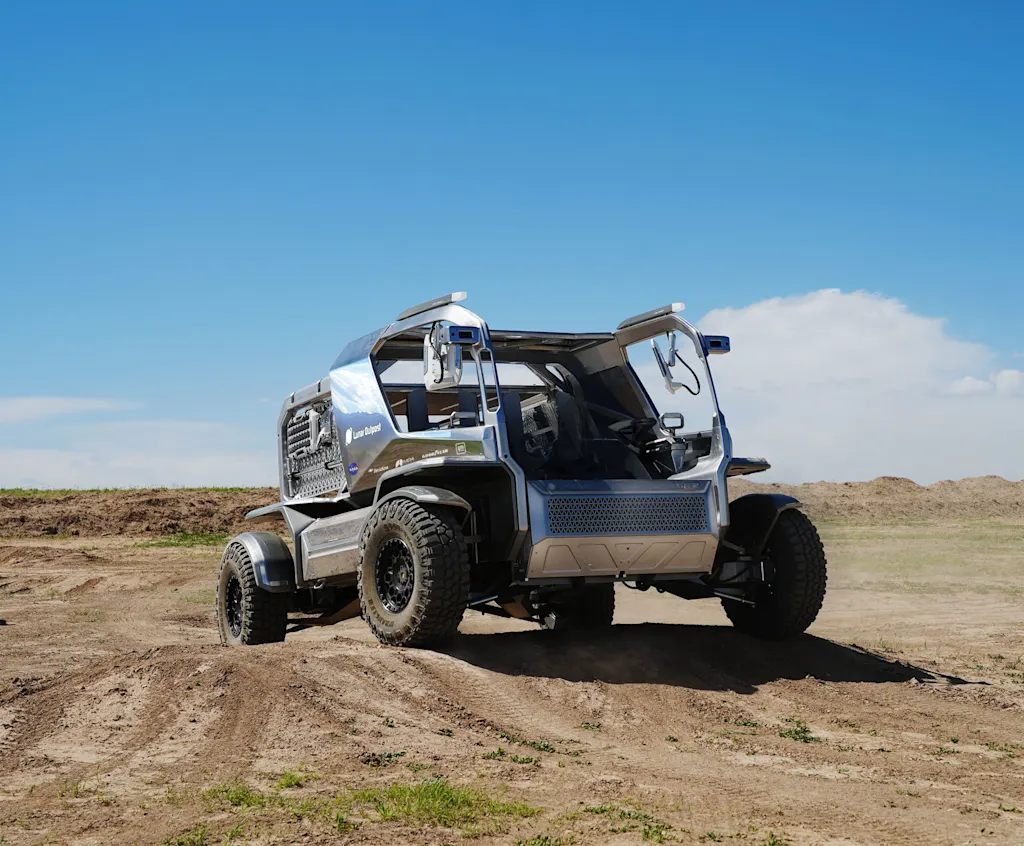
The energy system includes dual-sided solar panels to ensure one always faces the sun, and an advanced version of General Motors’ high-nickel lithium-ion battery cells that, with additional heating and insulation, can survive the 14-day lunar night and operate even if individual cells fail. An open cockpit with inlaid lighting and oversize control switches enables two astronauts, regardless of size, to easily access and operate in bulky spacesuits and gloves. Engineers incorporated feedback from astronauts who test-drove LTV simulators and prototypes.
“That was critical to evolving our design,” says AJ Gemer, Lunar Outpost’s CTO and cofounder. “We get used to moving here in this one-g Earth environment. When you translate that into a big, pressurized suit and one-sixth gravity, all your motions become different. Things that your gut and intuition tell you would be a nice, simple maneuver suddenly become more difficult.”
A 6.5-foot extendible robotic arm that attaches to the back of the vehicle can autonomously switch tool ends for tasks ranging from solar panel cleaning to sample extraction and handling to construction.
“All of the payloads on board need zero human interaction,” says Cyrus. “So, you can accomplish a lot of science and exploration objectives, even without astronauts on board.”
But the niftiest technology is the Goodyear-designed wheels—36-inch metal mesh tires with a little give and bounce for better traction, shock-absorption, and longevity. “This has a lot of advantages over other types of tires, which only have so many thermal cycles before they become brittle and crack,” says Cyrus. “If a spring comes loose or a section breaks, it doesn’t unravel the whole tire. These are better for vehicle dynamics at higher speeds, because they disperse the energy better when you hit obstacles.”
But space isn’t necessarily the limit. Cyrus envisions future Earthbound applications for Eagle technology, most notably in the electric farm and self-driving car markets, with lunar-grade batteries that can operate in any Earth winter, and autonomy and localization that can navigate without GPS.
“That is probably the most under-our-hat technology,” Cyrus says of the latter. “Because if we’re able to do that, what it offers is self-driving cars to go anywhere in the world and still know where you’re at without supporting infrastructure.”
An impassioned rise
Cyrus was still a kid when he first learned about the concept of sustainability in space. He’d grown up around the space industry, thanks to a dad who worked at NASA’s Johnson Space Center and later, Lockheed Martin. When JSC ran a competition for employee children to fashion new Lego space station designs, Cyrus’s entry missed the top spot, but yielded some serious inside baseball tips.
“’That’s cool that it unfolds and folds back up, but what are you gonna do with all the oxygen? How are you gonna refill the volatiles that you need for humans to survive?’” Cyrus recalls one engineer’s critique. “That was the first time I remember being passionate about figuring out where resources come from in space.”
The passion stuck. Later, while working as a Lockheed Martin engineer and pursuing graduate degrees at the Colorado School of Mines, he founded Lunar Outpost in 2017 to develop mobility and infrastructure for a sustainable human presence in space. He amassed a robust leadership team: older brother Julian, an aerospace engineer who now serves as COO; AJ Gemer, a dust science expert with eight space missions under his belt, as CTO; and Forrest Meyen as chief strategy officer. Meyen codesigned MOXIE (short for Mars Oxygen In-Situ Resource Utilization Experiment), a NASA demonstration technology on the Perseverance rover that produced oxygen from the carbon dioxide in the Martian atmosphere. “It’s very rare to have cofounders with that much experience at this stage,” says Cyrus.
Potential backers were less enthusiastic.
“I pitched 300 investors; not a single one said `yes,’” Cyrus laughs. “They’re like, `You’re crazy! Why would I invest in a lunar company?’”
So, the team pivoted to commercializing an air quality monitor, called Canary, that the company had designed for the International Space Station and NASA’s Lunar Gateway, a planned lunar-orbiting space station for the Artemis missions. Canary detects and analyzes pollutants, including methane, carbon dioxide, and carbon monoxide. It was a hit with the oil and gas industry and the U.S. Forest Service, selling some 5,000 units in more than 35 states and 14 countries to monitor forest fire emissions, air pollution, and industrial leaks.
“That gave us the revenue to invest in some of this advanced and deep technology,” says Cyrus. “Our revenue’s grown over two times every single year since 2017 to the point that these investors are like,`Alright, there’s something there.’ From 2017 to 2021, they saw us evolve and do exactly what we said we were gonna do. And that’s a rare thing in space.”
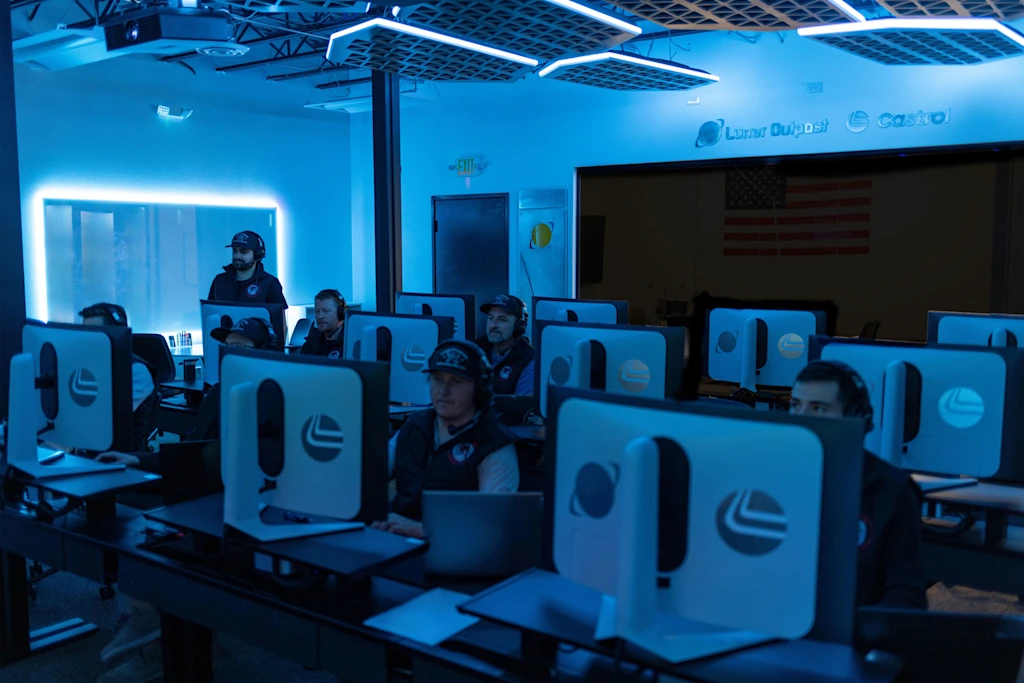
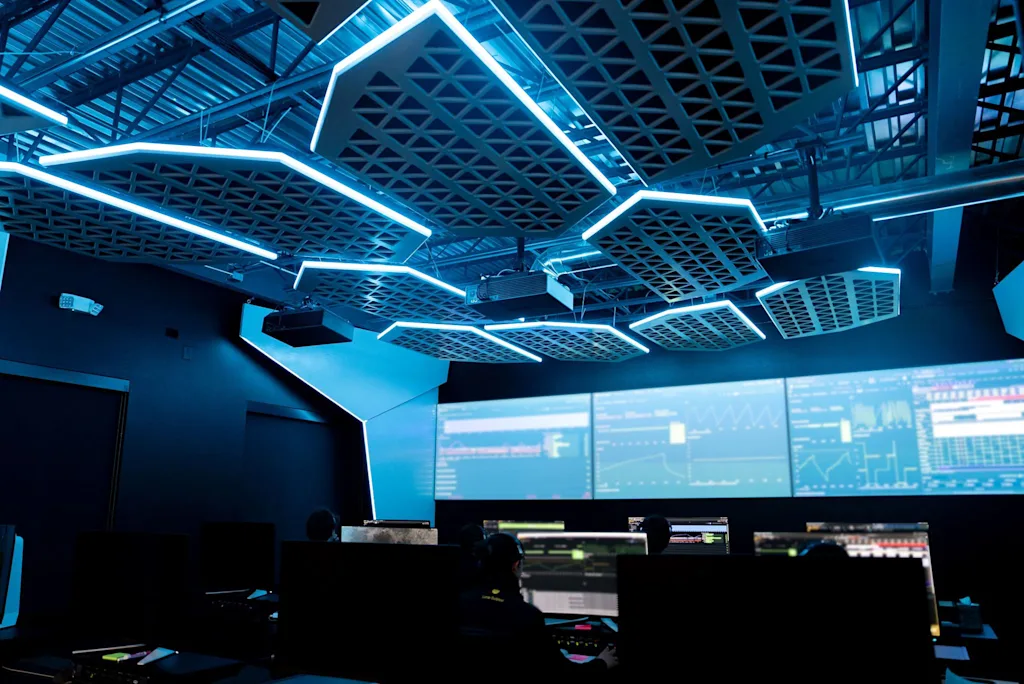
Since 2022, it’s raised $23.6 million, per market insight platforms Traxn and CB Insights, and grown to 140 employees in Colorado, Luxembourg, and Australia. (The staff also includes the youngest Cyrus brother, Austin, now a program manager.) As a private company, Lunar Outpost doesn’t disclose its revenues, though platforms such as Growjo estimate they’re just north of $50 million. It developed the LTV through partnerships with Leidos, MDA Space, Goodyear, and General Motors, while Castrol collaborated on its state-of-the-art mission control at its Golden, CO headquarters, which also includes design, manufacturing, and additional testing facilities.
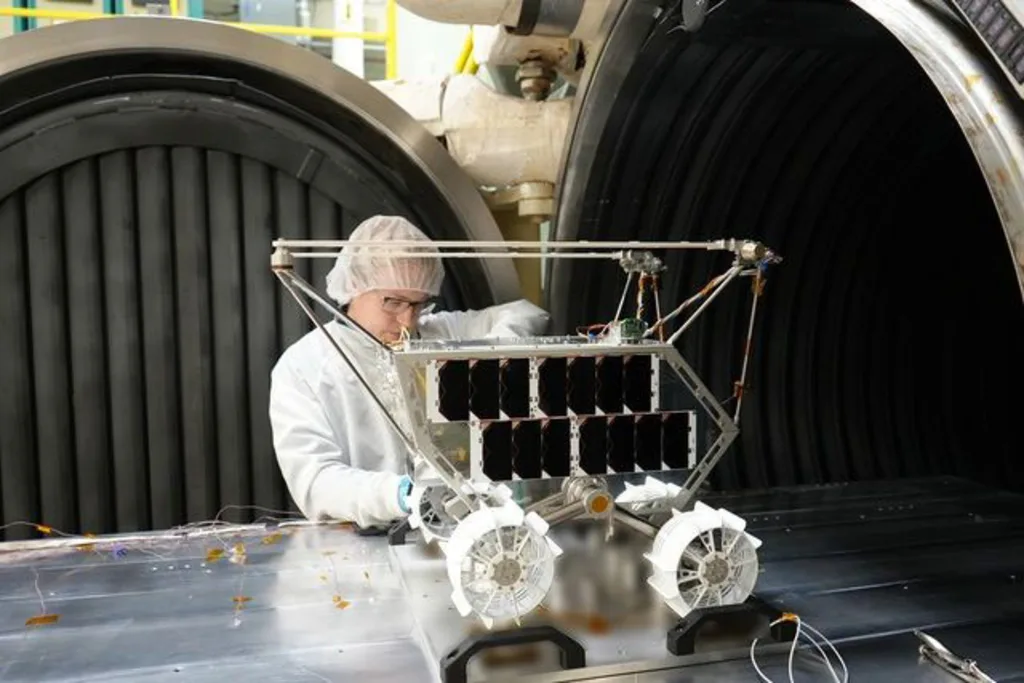
The last four years have seen two space ventures. From 2021–23, Lunar Outpost operated MOXIE on Mars. Last March, its Mobile Autonomous Prospecting Platform (MAPP) rover flew aboard the Intuitive Machines Athena lander as part of a mission to collect regolith samples and assist with the first lunar communications network. Unfortunately, Athena fell onto its side, trapping MAPP and preventing its deployment. Despite the setback, “we were able to do a full checkout in space and get a lot of data down,” says Cyrus. That journey will be chronicled in a 2026 documentary, Drive Me to the Moon.
Meanwhile, the company has another six lunar and cislunar missions planned. The company is developing Mobile Autonomous Robotic Swarms (MARS) software for the U.S. Air Force and U.S. Space Force, which it will test next year in low-Earth orbit. And four of its rovers are headed back to the moon. Next year, one MAPP will fly aboard a third Intuitive Machines lunar lander to investigate a magnetic anomaly at Reiner Gamma as part of the NASA/Johns Hopkins University Lunar Vertex mission. In 2027, one MAPP will ride a fourth Intuitive Machines lander to the lunar south pole, while an exploration class rover, dubbed Roo-ver, will carry scientific and commercial payloads for the Australian Space Agency’s first lunar mission. In 2028, another MAPP will join NASA’s Artemis IV DUSTER mission (short for DUst and plaSma environmenT survEyoR) to carry instruments that will characterize landing-site dust and plasma. Then there’s another mission the company can’t announce just yet.
The advancements from each mission inform the others. “We have spent about a decade developing critical technologies that we’re going to test on many missions before it ever gets to a lunar terrain vehicle,” says Cyrus. “So that way, we have a high degree of confidence that the astronauts are safe, and we can reliably perform the services that NASA needs. We are a lunar mobility company, so regardless of what happens with the LTV, we’ll keep moving.”
Another long-term vision is creating a legal and economic framework for mining space resources. Five years ago, NASA <a href="https://www.nasa.gov/news-release/nasa-selects-companies-to-collect-lunar-resources-for-artemis-demonstrations/" targe
Discover more from The Veteran-Owned Business Blog
Subscribe to get the latest posts sent to your email.

You must be logged in to post a comment.