Here are 5 steps to land your dream role

Full-time freelancing, Scott? Are you mad?! You can’t do this. You can’t do this. You can’t do this…
These were my thoughts nine months ago. Now, I’m on track to make six figures this year whilst working ~20 hours a week.
But it hasn’t all been smooth sailing.
Clients have ghosted me, opportunities have dried up, and applying for jobs has been exhausting.
However, I no longer have these freelancing worries.
That’s because one of my clients wants to bring me on board full-time in October, and I’m 90% sure I’ll accept. They’re even willing to sponsor me so I can move to NYC to be with my girlfriend!
So why the change of heart?
The last nine months have made me realise I don’t hate “the 9–5”. I just hated most of the jobs I’ve had up to this point in my life.
And I suspect you’re the same.
Let me explain.
“Feeling goals” vs traditional goals
“How we spend our days is, of course, how we spend our life.”
— Annie Dillard
When I committed to freelancing, I had a few North Stars.
I wanted to make $10K/month. I wanted to work from anywhere, anytime. And I wanted to spend more time with my family and friends.
Just as importantly, I set myself “feeling goals” (i.e. doing things that make me feel good).
Examples include:
- Going to the gym during off-peak hours
- Waking up without an alarm
- Showering during the day
- Zero client meetings
- 3-hour workdays

And I can still achieve these goals whilst working full-time.
Sure, I’m not curing cancer, and I may never be a millionaire. I’ve mourned the lives I won’t have.
But my work is having a positive impact on other people’s lives. I’ll also hit my goals and continue donating to non-profits like Tim’s Club.
That’s good enough for me.
So how can you land your dream 9–5 role?
NOBODY is talking about this.
It’s either 1) Work a day job and hustle after hours, 2) Part-time work + part-time hustle, or 3) Give up on your dreams.
But finding your dream job is a very real option.
I say 9–5. The hours can be flexible. My client is more interested in the work I produce rather than my schedule, so I think of it as full-time output rather than full-time hours.
Here are five steps I recommend to land your dream job.
Step 1) You’ve got to have skills
So give yourself at least 12 months.
I’ve published one to two articles a week since October 2020.
My early articles were terrible. I churned out 30 of them before people noticed. It took another 70 to find my voice.
I also worked in a range of SEO roles between 2019–2022, with my last role being the SEO manager for one of the UK’s largest online retailers.
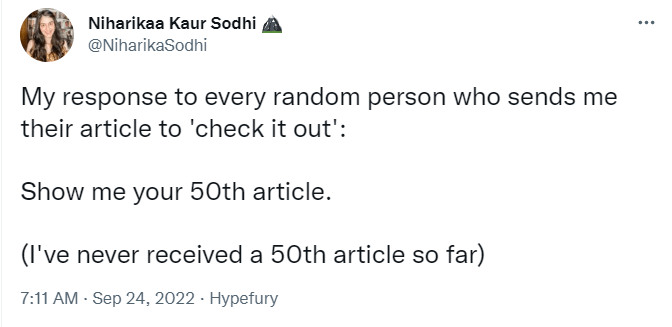
If you want to build a skill, there’s no shortcut.
It takes time to get good.
Niharikaa agrees:
And if you’re holding back on putting something out there because you want it to be perfect, remember:
Quantity *usually* leads to quality.
I’m not the only one saying this:
“Imagine if you met a comedian and they’re like, ‘I’m really focused on quality instead of quantity. I don’t do a lot of stage time…’
“You’d be like, ‘You’re a sh*tty stand-up comic.’
“The way you get good is by doing it a lot.”
Step 2) Portfolio > Anything Else
Start building yours today.
You need a portfolio to convince companies you’ve got the skills for the job.
Think of it as your coach, hype man, and best friend all in one.
A portfolio will:
- Tell companies why they should work with you
- Improve your skills
- Give you bearhugs
If you consistently add to your portfolio, it shows other things. You have sticking power. You’re serious about your craft. You want to get better.
Tick, tick, tick.
Step 3) Use this “Lazy Client Attraction” method
Well, lazy-ish.
You’ve still got to put in the work. But it’s lazy because you don’t have to apply for jobs or send cover letters.
Here’s how it works:
- When you find a creator/company you like, provide them with valuable content. For example, I wrote this article about a company called Passionfroot.
- If you’re writing an article, insert bit.ly links anytime you link to their website. This will let you track the link clicks.
- Once the content has gone live, email the creator/company. Here’s the email I sent to Akta at Passionfroot. I sent the email before the article went live, but you can send it after:
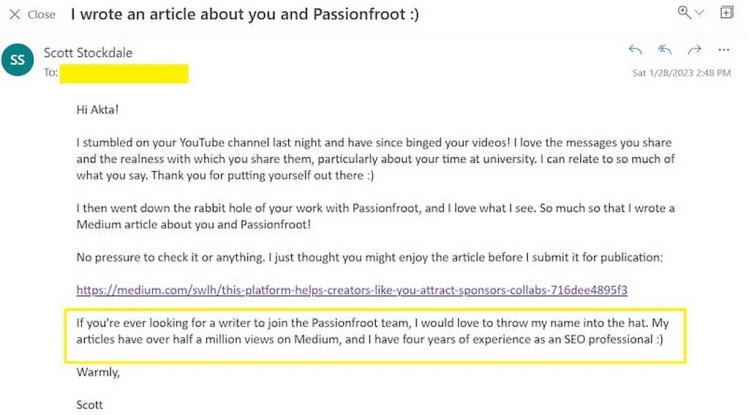
Notice that at the end, I float the idea of working together.
I’m not sure why I signed off with “Warmly”, as I’ve never used that before, but hey ho!
I sent the email above on a Saturday. The following Monday, Akta got back to me:
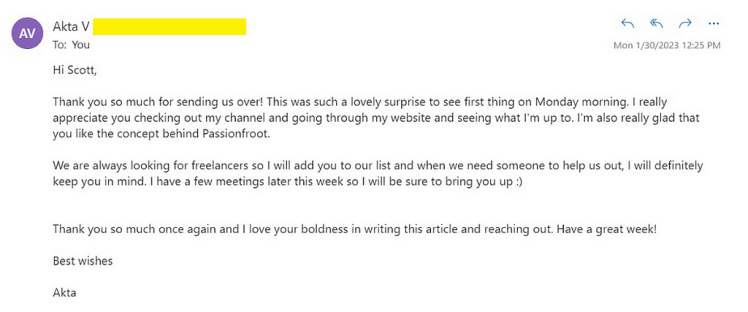
Pretty positive, I’d say!
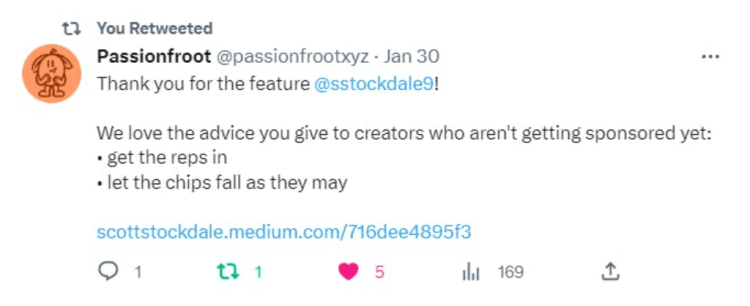
Passionfroot also shared my article on Twitter — and their CEO liked it:
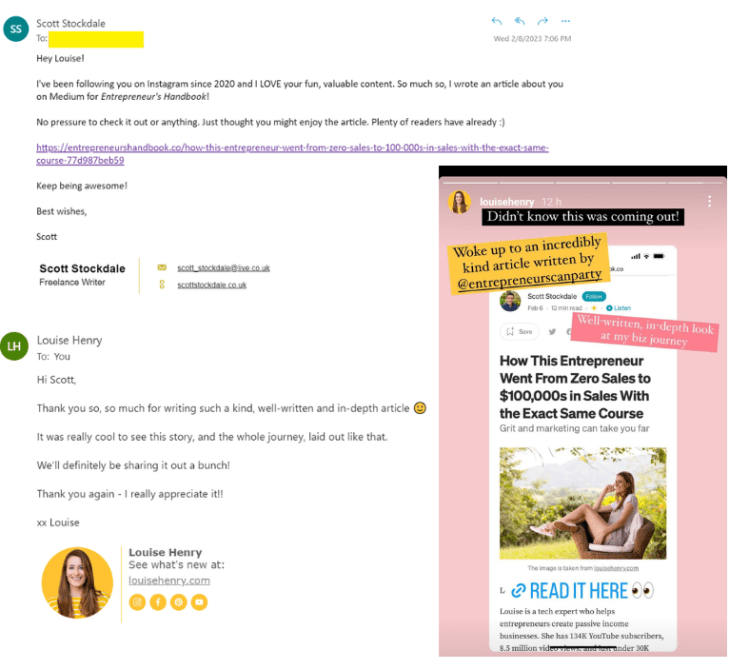
In a similar vein, I wrote an article about one of my favourite creators — Louise Henry.
And just like Passionfroot, I emailed her to let her know.
Louise’s response blew me away.
She replied back with a wonderfully warm email and shared the article on her Instagram stories (she has just under 30K followers):
And that was that.
Until…
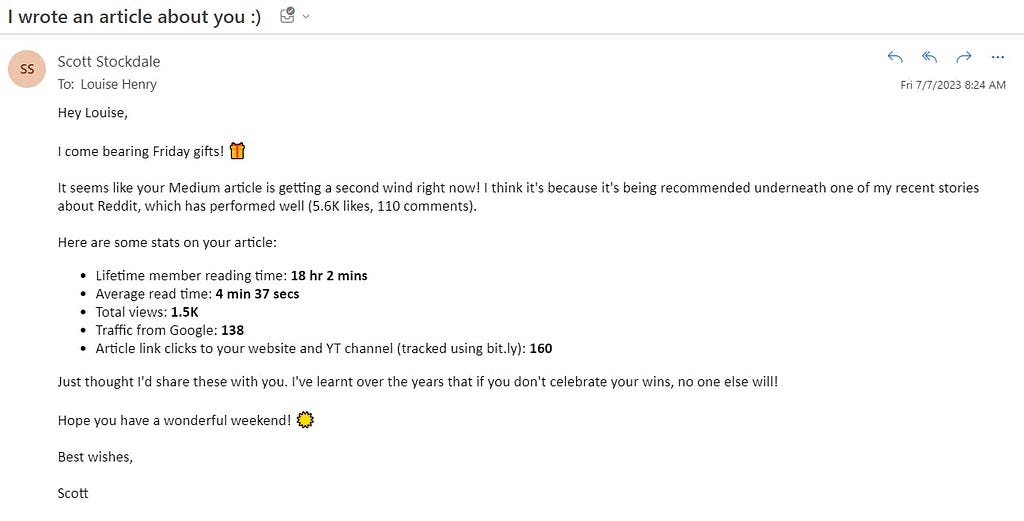
A few weeks ago, I noticed Louise’s article was getting picked up again, in part because one of my articles about Reddit had performed well.
I shared the good news with Louise in the same email thread as above (about 5 months after the original email):
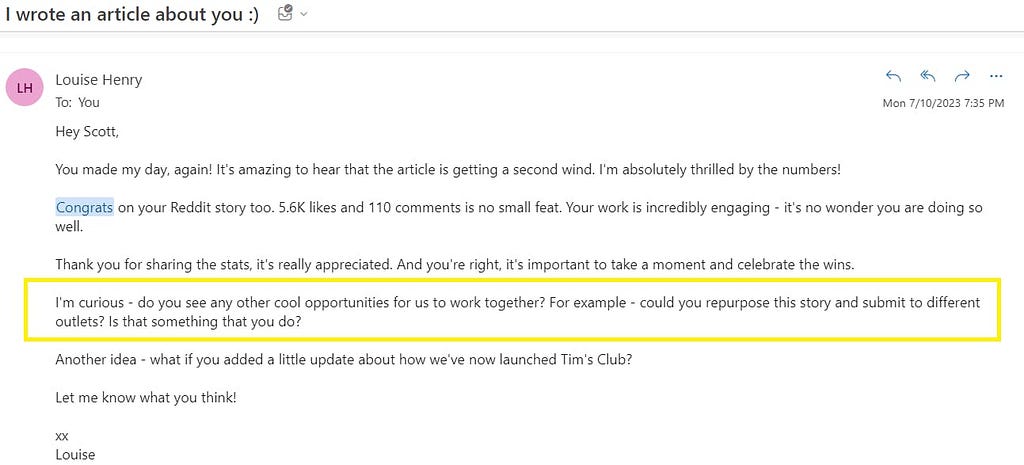
Again, she was extremely gracious and kind.
And she also floated the idea of us working together:
We’ve been in touch ever since.
Step 4) Share, share, share
Here are two recent examples.
A couple of weeks ago
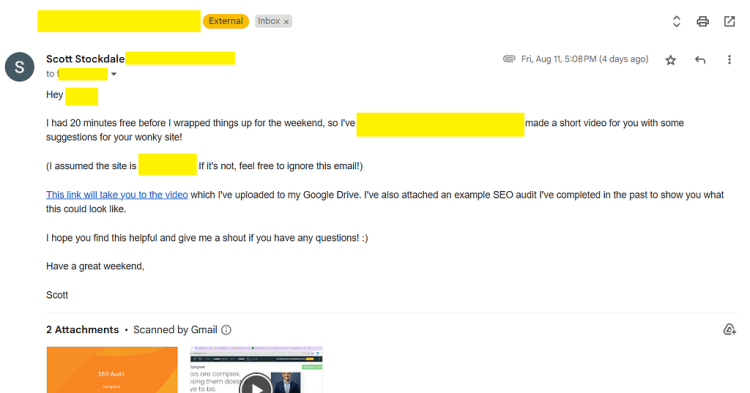
One of my old colleagues reached out on LinkedIn about doing an SEO audit:
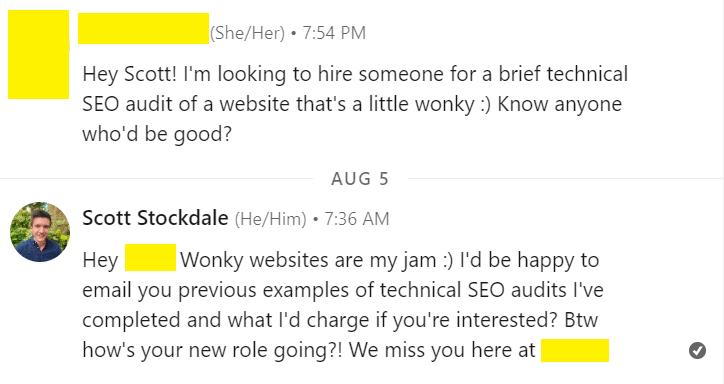
I followed up a week later via email.
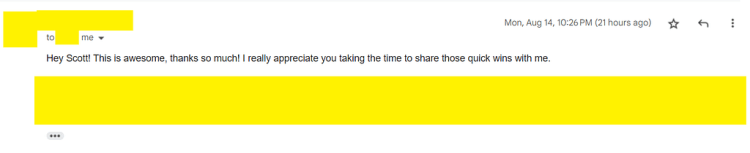
In the follow-up, I sent a 10-minute video to cover some quick wins. I also included an SEO audit I’d completed a few months ago as an example:
My old colleague liked it.
We’re now hammering out the details.
Yesterday
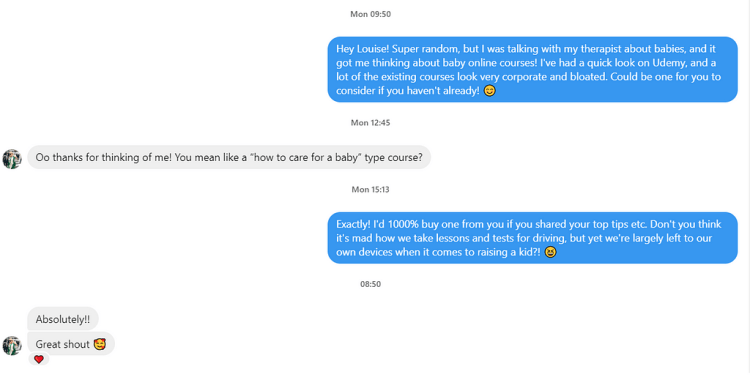
I reached out to my friend Louise about an idea for a new Udemy course.
She may or may not run with it.
Step 5) Be a sniper
If your dream job doesn’t arise from steps 3 or 4, keep looking out for opportunities.
I found the client who’s bringing me on full-time through this Patreon page, and I applied on a whim.
Here are some things to look out for:
- Companies that have been around for at least 10 years — I love this quote from Derek Sivers: “The longer something lasts, the longer it will probably last […] Something that’s been around for fifty years will probably be around for another fifty years.”
- Companies with between 10–50 employees — More than this, and you’ll get bogged down in processes. Fewer than this, and you won’t get the support or training you need.
- Companies that work remotely — If you’re forced into the office one day a week, you’ll be forced into other things you don’t want to do.
- Companies that have recently secured funding — If you’re working with a solopreneur, they’ll likely be more demanding than a small-size company. It’s the solopreneur’s money on the line.
- Companies that work in tech — You’ll work with smart, cool, hungry people.
Takeaways
If you follow all the steps in this article, I truly believe you can land your dream job in the next 12 months.
It’s taken me three years to get to this point, but I’ve made mistakes along the way.
You can get there sooner.
Here’s a quick summary of the steps:
- Step 1) You’ve got to have skills — Prove your worth, and companies will want to work with you.
- Step 2) Portfolio > Anything Else — A decent portfolio will do all the heavy lifting for you.
- Step 3) Use this “Lazy Client Attraction” method — Build your network by providing genuine value to others.
- Step 4) Share, share, share — You never know where it might lead.
- Step 5) Be a sniper — The best opportunities often come from the most unlikely places.
Get my free 19-page guide: Everything I Did to Quit My 9–5 Job & Transition Into Profitable, Sustainable Solopreneuring :)
You Don’t Hate “The 9–5”. You Just Hate Your Current Job. was originally published in The Startup on Medium, where people are continuing the conversation by highlighting and responding to this story.
SOURCE: https://ift.tt/VCGYot6 https://ift.tt/BuaPGqC
Discover more from The Veteran-Owned Business Blog
Subscribe to get the latest posts sent to your email.

You must be logged in to post a comment.