Foldable phones have spent years trying to justify themselves. Some were too fragile, others too bulky, and most felt like solutions in search of a problem. The Galaxy Z TriFold is Samsung’s clearest attempt yet to answer a more reasonable question: Can one device replace the phone-tablet combo without becoming a chore to carry?
Coming to the United States later this month, the TriFold folds twice, opens into a 10-inch screen, and closes back into a pocketable form. It’s an assertive design, but not a novelty play. Samsung seems very aware that this kind of device only makes sense for a specific kind of user.
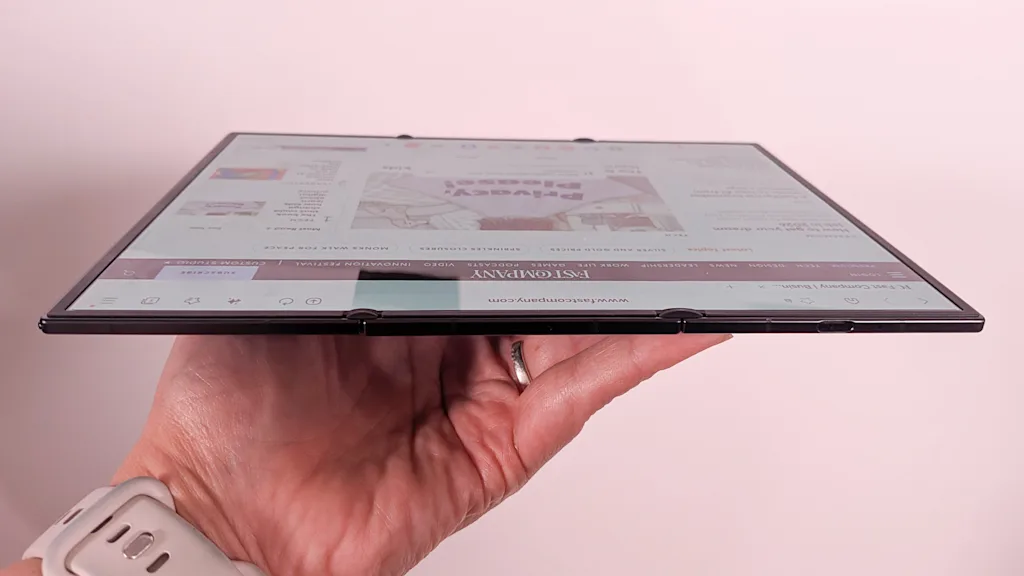
The double fold is the trick, but the software does the real work
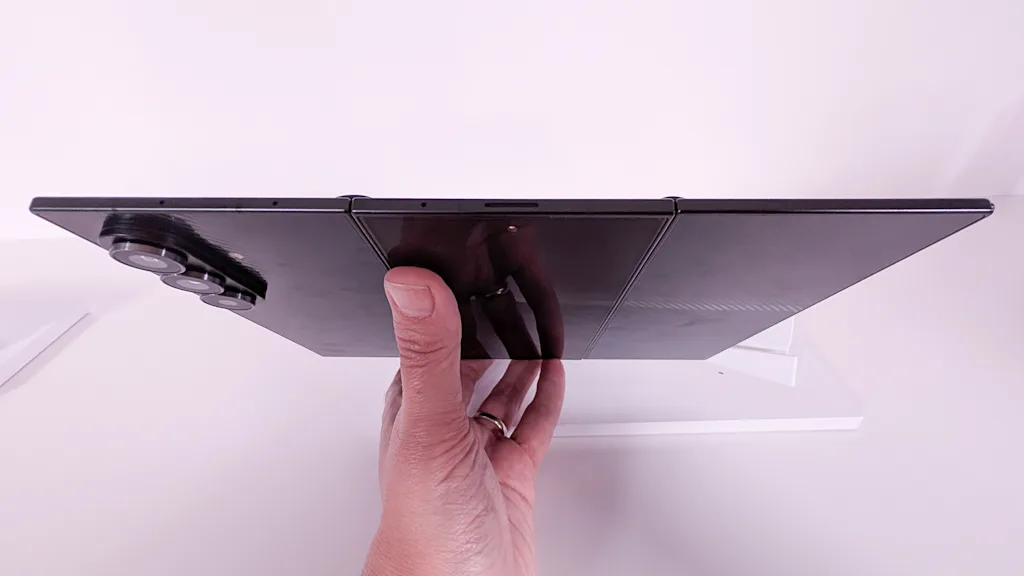
The headline feature is the dual hinge. Closed, the TriFold behaves like a premium smartphone. Open it fully, and it becomes a genuinely usable tablet-size workspace.
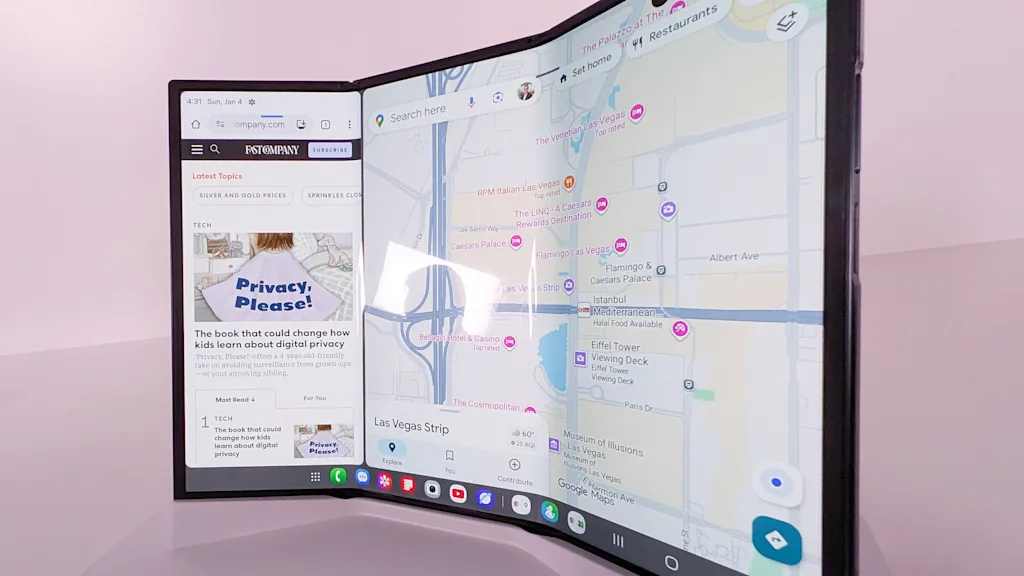
That space matters. You can run three apps side by side, resize them, and keep them anchored even when calls or notifications interrupt. Samsung’s task bar lets you jump back into complex layouts without rebuilding them, which is a small thing until you’ve lost your place mid-task one too many times.
We had a chance to try the phone first hand at a Consumer Electronics Show (CES) preview. The first time you open the device, the folding mechanism, in particular, stands out. Fully open, you might not even notice you’re holding a phone rather than a tablet. The three separate screens blend together seamlessly.
Samsung has also added guardrails. The phone will warn you if you’re folding it the wrong way when you go to put it away—which feels less like hand-holding and more like protecting an expensive mistake.
Editing photos is where the bigger screen actually shows off
The TriFold’s size gives Samsung’s photo tools room to breathe, especially its generative editing features. Blake Gaiser, head of smartphone product management, says the difference is immediately obvious once you start using them.
“We’re really well known for what we call generative editing—being able to remove things from a photo,” Gaiser told me during a demo this week. He took a photo that included a person, and then was able to select and remove that person from the photo in seconds. “It understands everything that I want to pick out here, and I’m able to take all the pixels out of that.”
He points to something that’s easy to miss on smaller screens: cleanup details. “Not only did it take the person out, but it took their shadow out as well,” he said. “So now I can look at both side by side each other, and you can see the shadow that she had there is gone.”
Being able to zoom in on before-and-after images simultaneously sounds minor. But for people who actually edit photos regularly, it’s the difference between trusting the result and hoping for the best.
This is very much not meant for everyone
The TriFold is not designed for everyone. Samsung isn’t pretending otherwise. Gaiser is blunt about the intended audience. “It is for your top productivity people,” he says.
That philosophy shows up most clearly in DeX (short for desktop experience), Samsung’s desktop-style interface. On the TriFold, DeX treats the device like a full monitor. You can resize windows freely, stack them, snap them into place, and even create multiple desktops that remember their layouts.
“So if I’m consistently looking at news articles and Samsung apps because I’m working on a piece or whatever, I could set those up in their own desktop,” Gaiser said. “Even when I clear the memory and everything, it remembers that setup.”
Gaiser has been using the TriFold as part of his own daily setup, and not always as the primary device.
“The two key things that I’ve done with this personally, in the three months that I’ve had this device: I have just a portable stand that I put it on, wireless keyboard, mouse, use it like a PC,” he said. “Or in my hotel room, I had my PC and I had this set up as a second monitor.”
The TriFold supports wired and wireless display output, including 4K when wired, making it less of a stretch to imagine it replacing a second screen for travel or temporary setups.
Built sturdier than it looks
Triple-folding phones raise obvious durability questions. Gaiser acknowledges the complexity.
“Because we have two different hinges on here. You have two different pivot points,” he said. The phone uses magnets to keep it shut, but also to give the third screen a gentle “pop” after you open the first, making it easier to lift.
Samsung also leaned heavily into materials, using ceramic glass fiber, a titanium lattice, and carbon fiber reinforcements to protect the folding display. Gaiser was candid in comparing it with competitors.
Power without cutting corners
Under the hood, the TriFold runs on a customized Snapdragon 8 Elite chip, includes a 200-megapixel camera, and uses a 5,600 milliamp-hour battery spread across its three panels. That complexity is invisible to the user—which is the point. The phone lasts through a full day of heavy use and charges quickly enough not to feel precious.
Samsung also worked with Adobe to create a subscription-based Lightroom-specific app that behaves like its desktop counterpart, reinforcing the idea that this device is meant for people who actually produce things on their phones. The phone will come with a free trial.
How it stacks up against other foldables
Huawei Mate XT
Huawei was the first with the Mate XT, proving that trifold hardware was possible. Availability is limited, software support is complicated outside certain markets, and it feels more like a statement piece than an everyday device.
Concept triple-folds from other brands
Several manufacturers have shown trifold concepts at trade shows. Most trifold devices are still prototypes, and that’s fine. Building one is hard. Making one that survives daily life, and the bumps that come with it, is even harder.
Samsung’s advantage isn’t that it folded a phone twice. It’s that it’s spent years figuring out hinges, software behavior, durability testing, and what users actually tolerate. The TriFold feels like the result of that learning curve rather than a shortcut.
So who should even consider this?
Samsung’s own answer is narrow. Gaiser calls the target audience “the top 1% heavy users.”
“Productivity tools, multi-window users, your ultra-top users,” he said. “It’s not for everyone.”
That honesty helps. The Galaxy Z TriFold isn’t trying to convince casual users to upgrade. It’s aimed squarely at people who already push their devices hard and want fewer things in their bag. It’s not flawless, not cheap, and not subtle. But it’s also the clearest signal yet that foldables are moving out of the experimental phase and into something more practical, even if only for a small slice of users.
source https://www.fastcompany.com/91471696/samsungs-galaxy-z-trifold-phone-ces
Discover more from The Veteran-Owned Business Blog
Subscribe to get the latest posts sent to your email.

You must be logged in to post a comment.