During President Donald Trump’s first administration, he left hundreds of government designers, across half a dozen or more agencies, to do their jobs.
But that changed the second time around, in January 2025, when a reelected Trump wasted no time turning the official White House website into his personal blog, deleting resources for topics ranging from reproductive rights to the contributions of Navajo code talkers in World War II.
Then in February, Trump took a sledgehammer to the digital infrastructure of the U.S. when he enlisted Elon Musk to lead the Department of Government Efficiency (DOGE). In a vast cost-cutting initiative, DOGE destroyed half a dozen of the government’s digital design agencies. Hundreds of talented people recruited over decades lost their jobs, according to the best estimates of former government designers. The teams who launched everything from healthcare.gov to that handy site for ordering free COVID-19 tests were decimated.
Now the design of America has been entrusted to one person overseeing the skeleton crews that remain. In August, Trump appointed Joe Gebbia as the country’s first chief design officer.

Gebbia is in charge of the America by Design initiative, and under Trump’s order has opened the National Design Studio “to improve how Americans experience their government—online, in person, and the spaces in between.”
“We’ll be guided by the best user experience,” Gebbia tells Fast Company. “It doesn’t matter who you voted for or what side of the spectrum you associate with or believe in. Everyone can agree that government websites are underwhelming, and they would enjoy a better design, better user experience, and faster page load times.”
It’s an attractive promise, made by a man who, in many ways, appears to be a great fit for the job. Gebbia is the billionaire design cofounder of Airbnb. He graduated from the prestigious Rhode Island School of Design. He’s a fast-moving, private-sector creator of one of the most popular digital services of the past 20 years. His CV is exactly right for America by Design’s mission, which is to make chores like applying for your citizenship or filing taxes “something you actually look forward to.” It’s a Silicon Valley mantra that’s overused and overly optimistic, but it’s also fundamentally hard to argue with.
Yet in speaking to a dozen government designers and experts for this piece—serving across the Obama, Trump, and Biden administrations—it’s clear that Gebbia’s biggest challenge isn’t making the drudgery of navigating government services delightful or even easy. It’s navigating the inherent tension of doing so in an administration that’s actively undermining basic human rights.
“You can’t talk about people losing their Medicare and have a slick website,” says Paula Scher, partner at the celebrated graphic design firm Pentagram. “It just doesn’t go.”
Gebbia, who promised his fortune to the Giving Pledge in 2016, has recently positioned himself as a MAGA Republican who challenges vaccinations and has promoted the idea on X that immigrants should lose their green cards. Still, his ideologically opposed peers continue to believe that the power of design triumphs over all. That includes his Airbnb cofounder Brian Chesky, who defends Gebbia’s position and the good he can do as a pure digital practitioner.
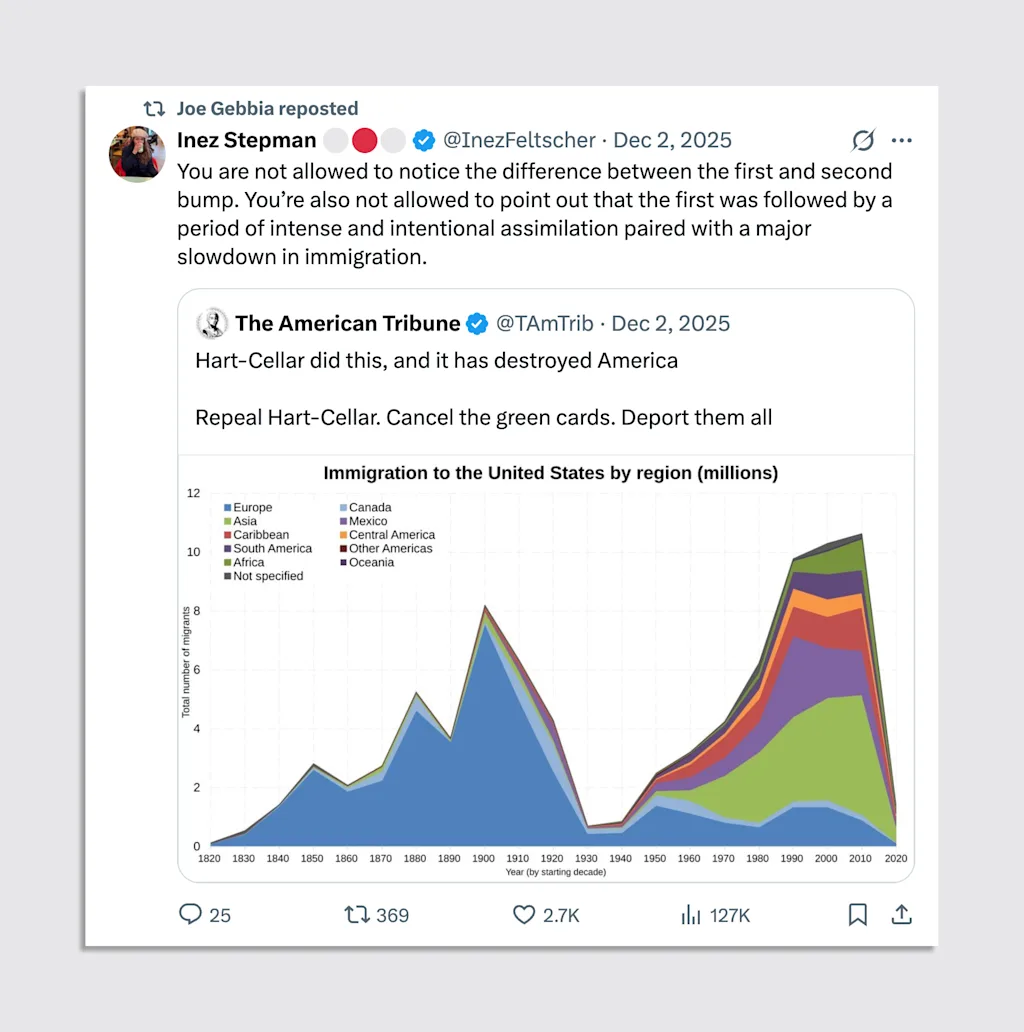
“As you think about it, the way that most people interface the U.S. government is through an app or a website,” says Chesky. “If those apps or websites were easier, so you could visit a national park, pay your taxes, get your benefits or Veterans Affairs stuff, that’s a good thing. It’s not inherently political.”
But the work has been political. Months into his appointment, Gebbia’s promise to fix the UX of American services is far from realized. Instead, the Trump administration has traded several flawed but human-centered government design agencies for a red-pilled web 2.0 propaganda czar.
In his time as chief design officer, Gebbia has launched half a dozen websites that don’t so much repair the online experience of the U.S. government as promote Trump’s projects like Kickstarter campaigns reskinned in vintage Apple typefaces. The high-gloss websites for Trump Accounts and the Genesis Mission might give the appearance of an Apple Store-like experience, but Gebbia’s designs have also gone live with hundreds of accessibility violations.
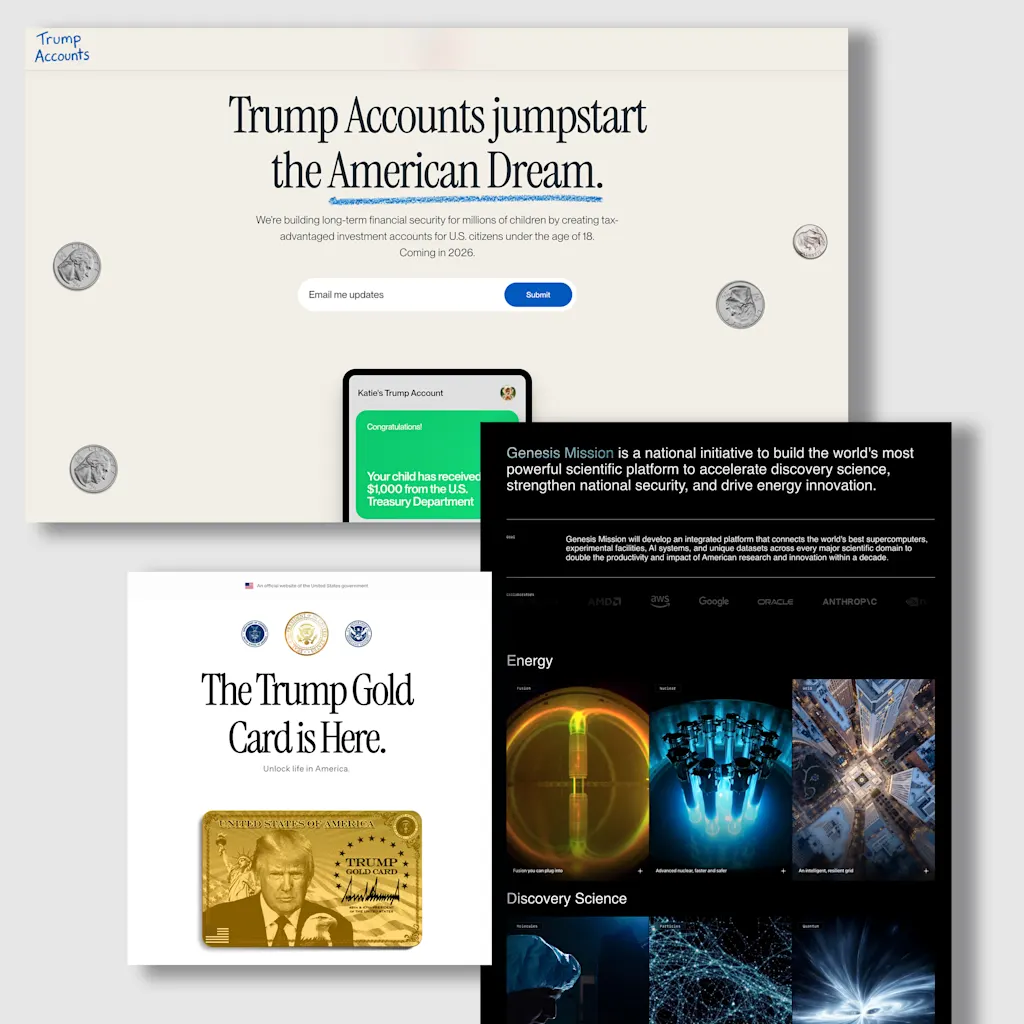
At best, the work has been cringe (have you seen the Trump gold card?). At worst, it has distracted from an erasure of human rights, as trans resources and even practical words like disability have been purged from government websites this year.
Still, many of the people I spoke with exhibited a certain envy for the position Gebbia finds himself in. It’s an unprecedented moment in which design has been elevated to the top of the country, backed by an executive order to get things done. With the assistance of Musk, Trump razed America’s design services as we know them, leaving nothing in Gebbia’s way to build anew.
“He’s inheriting the blank check kind of environment . . . [so] according to the laws of physics, he should be able to get a lot done,” says Mikey Dickerson, founding administrator of the United States Digital Service (USDS). “But if the things that he’s allowed to do, or the things that he wants to do, are harmful, then he’ll be able to do a lot of harm in a really short amount of time.”
Redesigning the government
In January 2025, Josh Kim was working for the State Department through a private contract agency, building the department’s updated digital accessibility standards. A dashboard tracked all the pages the government needed to modernize, from passport applications to adoption pages, to ensure everyone could access them.
Following Trump’s reelection, the administration sent out a memorandum to end DEIA (diversity, equity, inclusion, and accessibility) projects—with a mandate to cancel all related private contracts. Kim says he was told by management to erase every mention of “disability” and “accessibility” from his work immediately, before his firm was audited or asked to do so.
“There was definitely this wave of fear that the consultancies were kind of like, ‘Oh shit, they’re going to cancel our contracts if we mentioned any of these things,’” Kim says. His experience was far from isolated. In the early days of the Trump administration, similar erasure happened across government design agencies—with much of the work documented on GitHub.
It wasn’t just words that were lost in this purge. One week after the memorandum, the Veteran’s Affairs site relabeled “Accessibility at the VA”—a webpage that allows disabled veterans to flag interface issues—to “508 Compliance (accessibility).” The code refers to the law for IT accessibility, but sounds like a plot twist from Stranger Things.
While the page still exists, it’s the kind of update that obfuscates information to many of the people who need it. A third of veterans rely on the VA for disability benefits, and the update fundamentally damages the feedback loop between the government and the people it serves.
It’s but one example of how government design services readied themselves for an invasion, and an invasion they got. In February 2025, Musk’s DOGE team arrived in D.C. and began cleaning house. By March, hundreds of government designers were gone as the most powerful design agencies inside the government were functionally dismantled.
The (sometimes necessary) pangs of democracy
Modernizing UX has been a big initiative of the government since President Barack Obama launched the Office of Digital Strategy in 2009 to connect the White House to digital channels. He then established a Presidential Fellows program in 2012 to recruit a new wave of technologists to public service. To date, 250 people have joined for 12- to 24-month tours of duty, including product leads on the Nest thermostat, Nike+ FuelBand, and talents who had worked at Disney.
Even with this added technological firepower, government services still needed more day-to-day design support. That arrived in 2014, when two critical internal agencies—the USDS and 18F—were created out of one of the biggest digital failures in U.S. history, the botched launch of healthcare.gov.
On the day healthcare.gov launched in 2013, 250,000 people tried to purchase health insurance, only to find a website that was unusable, with dozens of problems ranging from account registration failure to frequent crashes. It was so bad that only six people were able to sign up for healthcare coverage on the day of launch.
Mikey Dickerson recalls arriving from Google to found what would become USDS. His first job of fixing healthcare.gov was done in just two months, from October to December 2013.
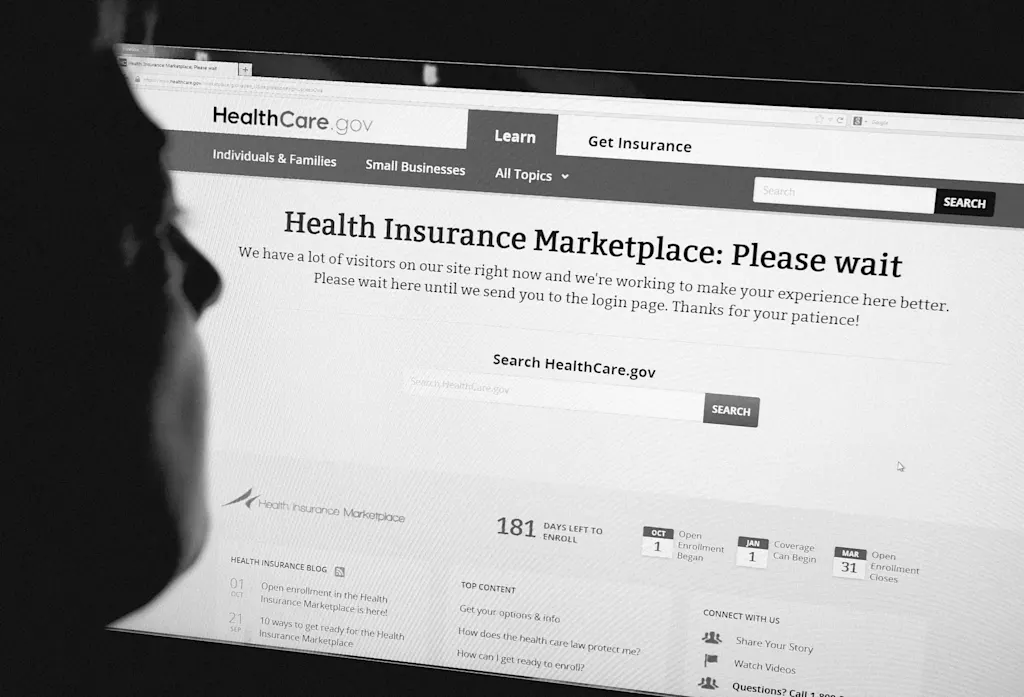
“I mean, that was approximately a miracle, honestly,” he says, noting that entrenched government employees got a wake-up call from a disgraced Obama administration. “This was a very rare case where doing nothing was going to have consequences, because doing nothing meant that this very visible policy failure wiped out all of their careers.”
Both the USDS and 18F doubled down on longer-term, private-sector recruiting. These two organizations alone recruited 18 people from Google, along with talents from Amazon, Facebook, Twitter, and the popular Silicon Valley incubator Y Combinator. Nikki Lee, a former product manager at 18F, created the stylus interaction used by Windows 10 and 11. The recruiting effort was enough to catch the attention of OpenAI cofounder Sam Altman in 2015, who called the talent grab “on par with the best Silicon Valley startups.”
It’s a recent history that Gebbia has entirely ignored when promising to build a “dream team” of the “best talent of our era—the best designers, the best software engineers”—as if that’s a new concept for the government. (A government initiative called Tech Force launched in December 2025 to address the government’s loss of talent under DOGE.)
When I ask Gebbia about his thoughts on the USDS and 18F—and whether he thought these groups were overrated and needed to be rebuilt—he shrugs off the topic as before his time.
“Without knowing too much about the groups you mentioned, I do know that the air cover and the urgency around design is in a place it’s [never] been before,” he says.
Whether Gebbia acknowledges them or not, USDS and 18F offer precedent for America by Design. The agencies were designed to work across different parts of government. USDS was a crisis agency focused on triage. 18F was an internal design consultancy built for longer-term digital solutions. Combined, they had an approximately 350 head count at their peak with a combined budget of around $40 million (though the USDS received a $200 million grant in 2022 to invest in tasks like modernizing Social Security IT and getting low-income Americans online).
It’s easy to frame the progress across a constellation of government design services as too slow, too bureaucratic, and, most of all, too unusable. No one recognized these issues more than the government designers working to address them.
“It is not like a corporate setting. It is not like a nonprofit setting. It is not like higher ed,” says Rachael Dietkus, the first social worker hired at USDS, who describes her first two years of working for the government as very difficult. “The learning curve is absolutely massive. It can be very confusing. There is a lot of hierarchy.”
These agencies weren’t perfect, but they represented progress. Yes, they still had to operate around entrenched government employees who weren’t always motivated to move fast. But the bigger obstacle was often legislation the government had already decided upon.
“Sixty percent of why the design of things sucks is because the policy sucks,” Dickerson says. “If you wanted a SNAP [Supplemental Nutrition Assistance Program] application to be really simple, like, you could absolutely do it. You could do it the same way we did the [free] COVID test.”
When the government sent out free COVID-19 tests in 2021, policymakers decided that they could be available to anyone who requested them. “We’re not going to go around checking whether you have the money. If you wanted to do that exact same program but you want to do it means tested, where I have to prove that I can’t afford my own COVID tests? Well, guess what? Now you’ve got an application process that is nine months long. And we’ll have an appeal, and an appeal to the appeals,” Dickerson says.
Her point mirrors what I heard from many government designers: You cannot have simplicity in government services in the face of eligibility verification, legal due process, and the ability to apply for services without a computer. That’s ultimately why many digital services aren’t as simple as the public would like.
Clare Martorana, who was appointed chief information officer under President Joe Biden, left the role alongside that administration. She updated legacy systems that had been infiltrated by China and Russia, launched IRS direct file with 18F and others to sidestep the TurboTax ecosystem, and responded to the pandemic with the aforementioned COVID-19 test site (developed alongside the U.S. Postal Service by a handful of designers) that simply made tests appear at your door, no questions asked.
But a lot of Martorana’s job was simply keeping projects moving, and to circumvent old, dated policies that perpetually impeded her work. “I received numerous emails from [managers] asking me, ‘There’s a guy here in our team that won’t move forward with this thing because of this 1995 e-government [policy]. And can you please write me back so I can share that, from your vantage, sitting under the president, your interpretation is that this is no longer the primary regulatory thing that someone should focus on?”’ she recalls. “But you know, we over-indexed in adding new rules and regulations and never did the housework of cleaning our closets.”
As an o
source https://www.fastcompany.com/91458973/chief-design-officer-joe-gebbia-reshaping-the-government
Discover more from The Veteran-Owned Business Blog
Subscribe to get the latest posts sent to your email.

You must be logged in to post a comment.