Want more housing market stories from Lance Lambert’s ResiClub in your inbox? Subscribe to the ResiClub newsletter.
The average price net of incentives of new-builds sold by Lennar—America’s second largest homebuilder—came in at $386,000 in Q3 2025. That’s down -10.2% from $430,000 in Q4 2024 and down -21.4% from $491,000 in Q3 2022.
While last quarter Lennar acknowledged that it will no longer be as aggressive in prioritizing volume over margin going forward, the giant homebuilder said that doing so (i.e., volume > margin strategy) over the past few years helped it gain market share while some other builders were more conservative.
“During the past three years of difficult market conditions, we have maintained volume, we’ve grown market share, and we’ve re engineered our operating platform for a better and more efficient future when the market bottoms and normalizes, we’re extremely well positioned with very strong market share in strategic markets, and our margin is leveraged to the upside,” Stuart Miller, co-CEO of Lennar, said on the homebuilder’s December 17 earnings call.
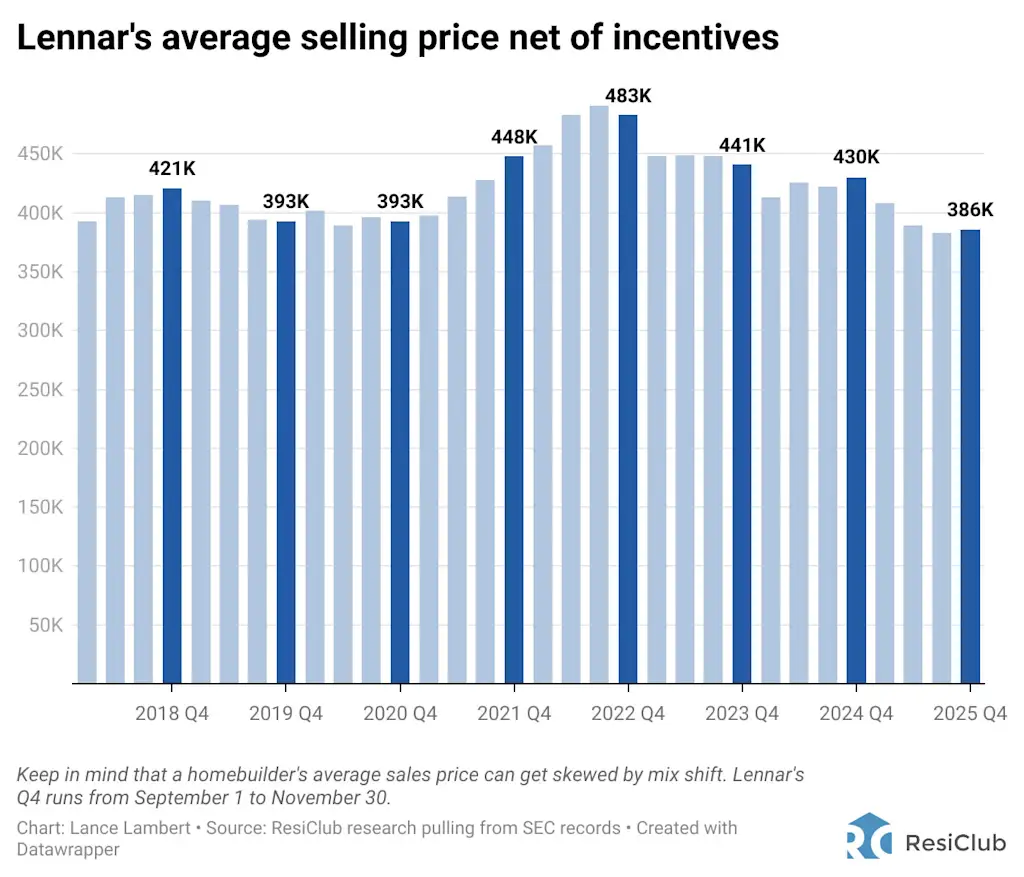
While there’s undoubtedly weakness in the housing market—in particular in pandemic era boomtowns in Texas and Florida—Lennar’s headline drop in home prices might be giving the impression of a greater home price correction than the homebuyer is actually seeing.
See, Lennar’s average selling price, net of incentives, reflects the average selling price after incentives are deducted—it is not the actual price paid by the typical homebuyer before incentives.
While some of the average selling price decline is due to outright price cuts and some to a mix shift toward smaller homes, the biggest driver is aggressive incentive spending—primarily through mortgage rate buydowns.
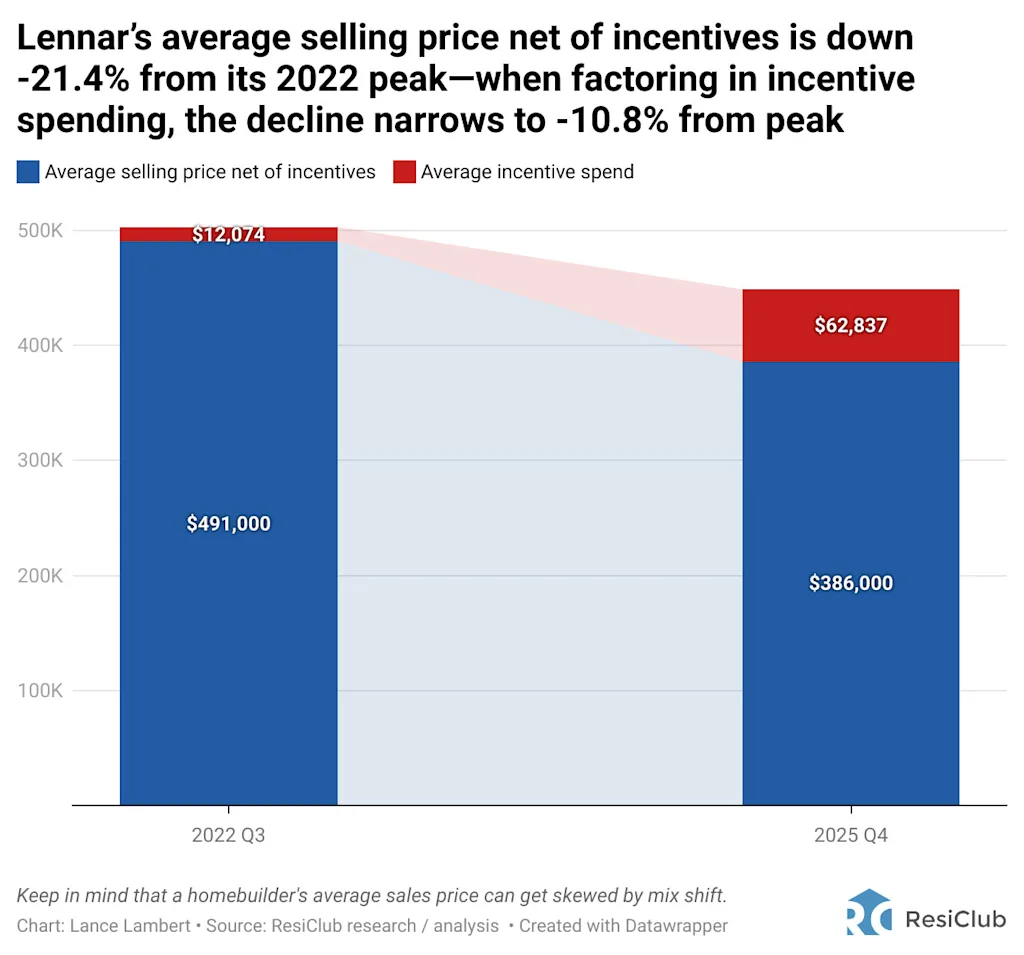
To isolate the impact of incentives, ResiClub reverse-engineered Lennar’s sales-price math.
ResiClub estimates that in Q3 2022, Lennar spent roughly $12,074 in incentives on a typical home sale. By comparison, in Q4 2025, typical incentive spending by Lennar had risen to about $62,837 per home.
When accounting for incentive spending, the typical Lennar homebuyer in Q3 2022 paid around $503,074. In Q4 2025, the typical Lennar homebuyer paid about $448,690—roughly 10.8% less than in Q3 2022, which marked Lennar’s peak quarter.
With incentives now accounted for, the outstanding question—which ResiClub can’t answer just yet—is how much of that 10.8% decline reflects mix shift versus outright declines in home prices?
“As you may recall, last quarter, I noted that declining interest rates could signal the start of a market recovery. Unfortunately, that turnaround has not yet materialized. As [mortgage] rates slowly moderated in September, eased more in October and remained flat in November, the customer response remained fairly tepid, suggesting that a combination of affordability and consumer confidence issues were continuing to limit demand,” said Miller on the earnings call.
Miller added that: “While traffic was consistent, customers were both hesitant and limited by what they could afford to purchase. With that said, our fourth quarter results show the continued softening of market conditions and affordability. Sales volumes have been difficult to maintain, and required additional incentives to achieve our expected pace and to avoid an unintended buildup of excess inventory.”
Discover more from The Veteran-Owned Business Blog
Subscribe to get the latest posts sent to your email.

You must be logged in to post a comment.