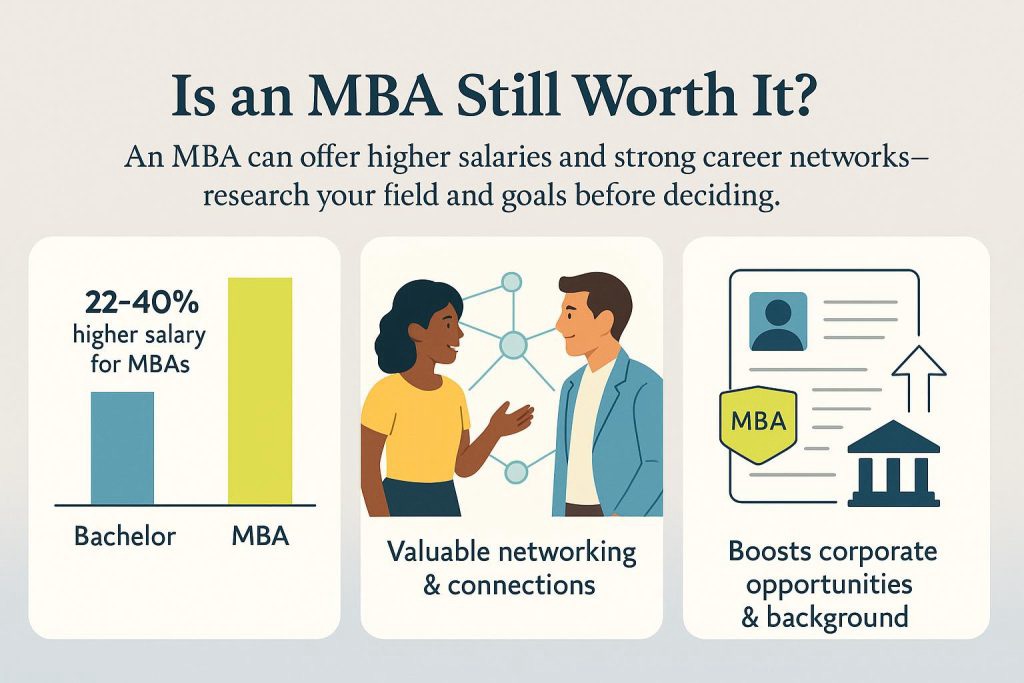
Recent graduates of top business schools are no longer finding their degrees are opening recruiters’ doors. 🎓
The Master of Business Administration (MBA) has long been considered the “golden ticket” of the professional world—a reliable fast track to six-figure salaries, corner offices, and executive prestige. However, according to a recent analysis by Bruce Crumley in Inc., that gold may be losing its luster. In his article, “The Job Market is Shrinking for MBAs Too,” Crumley highlights a sobering reality: even the most elite degreeholders are feeling the squeeze of a tightening economy and a shifting corporate landscape.
A Shift in Corporate Demand
For decades, top-tier consulting firms, investment banks, and tech giants hired MBAs in massive cohorts. But as Crumley points out, the hiring frenzy of the post-pandemic era has cooled significantly. Many of these traditional “MBA pipelines” have slowed their intake, deferred start dates for new hires, or in some cases, paused recruitment altogether.
This isn’t just a temporary dip; it’s a reflection of how companies are rethinking the value of a high-priced generalist. In an era where “lean” is the buzzword, many firms are opting for specialized skills or promoting internally rather than paying the hefty premium that comes with a fresh MBA graduate.
The Rise of Specialized Skills Over General Management
One of the most compelling points in the Inc. piece is the evolving nature of what employers actually need. While an MBA teaches strategic thinking and high-level management, today’s market is increasingly hungry for technical proficiency. Whether it’s data science, AI implementation, or specific industry expertise, the broad “general manager” archetype is finding it harder to compete with the “specialized expert.”
Companies are becoming more surgical in their hiring. Instead of bringing in a generalist to solve a problem, they are looking for candidates who can hit the ground running with specific tools and technical insights. This shift puts MBA graduates—who often spend two years and hundreds of thousands of dollars on a broad curriculum—at a crossroads.
The “Cost vs. ROI” Dilemma
Perhaps the most daunting takeaway for prospective students is the return on investment (ROI). With tuition costs at top-tier business schools reaching astronomical levels, a shrinking job market makes the financial math difficult to justify. When the “guaranteed” landing spots at McKinsey or Goldman Sachs become more competitive and less frequent, the risk profile of the degree changes.
Crumley’s article serves as a warning: the degree itself is no longer a shield against market volatility. Candidates can no longer rely on the prestige of their alma mater alone; they must now prove their tangible value in a way that goes beyond a resume credential.
The Path Forward: Adapt or Be Left Behind
So, is the MBA dead? Not necessarily. But as the Inc. article suggests, it is being redefined. To thrive in this shrinking market, MBA candidates must:
- Pivot to Tech and AI: Understanding how to manage and implement emerging technologies is no longer optional.
- Focus on Niche Expertise: General management is great, but pairing it with a specialty (like supply chain or healthcare) offers more security.
- Network Aggressively: With fewer “campus pipeline” roles available, the hidden job market—driven by personal connections—is more important than ever.
The job market for MBAs may be shrinking, but for those willing to adapt, there is still a path to success. The “golden ticket” might not open every door anymore, but for those who combine the degree with high-demand skills, it still remains a powerful tool in a professional arsenal.
👁️ READ MORE via https://ift.tt/YF3Dw7T
Discover more from The Veteran-Owned Business Blog
Subscribe to get the latest posts sent to your email.

You must be logged in to post a comment.