It’s a little-known fact that Columbia University, in Manhattan, was home to the first mining school in America—the School of Mines—founded in 1864.
For the past three decades, the university’s program has been mothballed. Parts of its curriculum were subsumed into the more fashionable subjects of earth and environmental engineering.
But next fall, Columbia University will offer a bachelor of science degree in mining engineering once again.
Other schools are barreling down, as well. The University of Texas at El Paso is also relaunching its mining engineering degree, starting in the fall of 2027, after a 60-year hiatus. The University of Texas system is providing $20 million to reestablish the program, which plans to produce up to 100 mining engineers annually. Existing programs at some of the top schools for mining—including the Colorado School of Mines, the Missouri University of Science and Technology, and Montana Technological University—are also reporting upticks in enrollment, reversing years of declines.
“Until the 1970s, most universities had pretty robust programs in mining engineering,” says Greeshma Gadikota, professor of earth and environmental engineering at Columbia University, who will also teach in the revived mining program.
This rebirth in mining education in the United States is happening for a reason. It’s a response to a crisis that’s been decades in the making.
The underground scene
In key measures of mineral wealth and production, the U.S. is failing to keep up. Rising global demand across clean energy, defense, and tech industries has driven prices for critical minerals like copper, silver, and tungsten to record highs. Geopolitical tensions have threatened access to many others.
For decades, the U.S. had deprioritized mining and has instead come to rely on rare minerals produced in China. China dominates production of at least 15 critical minerals and mineral groups; it mines about 70% of the world’s “rare earth elements” and processes about 90% of the global supply. (The U.S. is entirely dependent on China to meet its demand for graphite, an essential component in lithium-ion batteries, for example.)
But over the past year, in retaliation for Trump’s tariffs, China has banned the export of three rare earth products—gallium, germanium, and antimony—to the U.S. And it has put export restrictions on many others, including ones for which China is the sole supplier, including dysprosium, essential for building superfast computer chips, and samarium, a rare earth metal used in many military applications. Last fall, prices for gallium (used in electronics, semiconductors, and batteries) and germanium (critical to infrared technology used in fighter jets and missiles) hit a 14-year high.
Tapping into a domestic supply of rare minerals has become not just an economic imperative for the U.S. but a strategic one. Yet that requires rebuilding a declining workforce. More than half the people currently working in the U.S. mining industry—roughly 221,000 workers—are expected to retire or switch industries by 2029. The U.S. Bureau of Labor Statistics forecasts 400 annual job openings for mining engineers through 2034.
That may not sound like a lot—after all, the Bureau of Labor Statistics anticipates about 5,500 annual openings for civil engineering technologists and technicians, and 17,500 openings for electrical and electronics engineers in the same period.
But consider that in 2023, only 312 mining engineering degrees were awarded by U.S. universities. That means it’s a seller’s market for new mining grads—a stark contrast to the outlook for computer science graduates and computer engineering majors, who faced 6.1% and 7.5% rates of unemployment, respectively, according to the Federal Reserve Bank of New York. (It’s no wonder Nvidia CEO Jensen Huang says he would study physical science if he were starting out today.)
But the ability of the U.S. to mint new mining engineers is limited by the number of schools that still offer mining and mineral engineering programs, which has fallen from 25 in 1982 to about a dozen today.
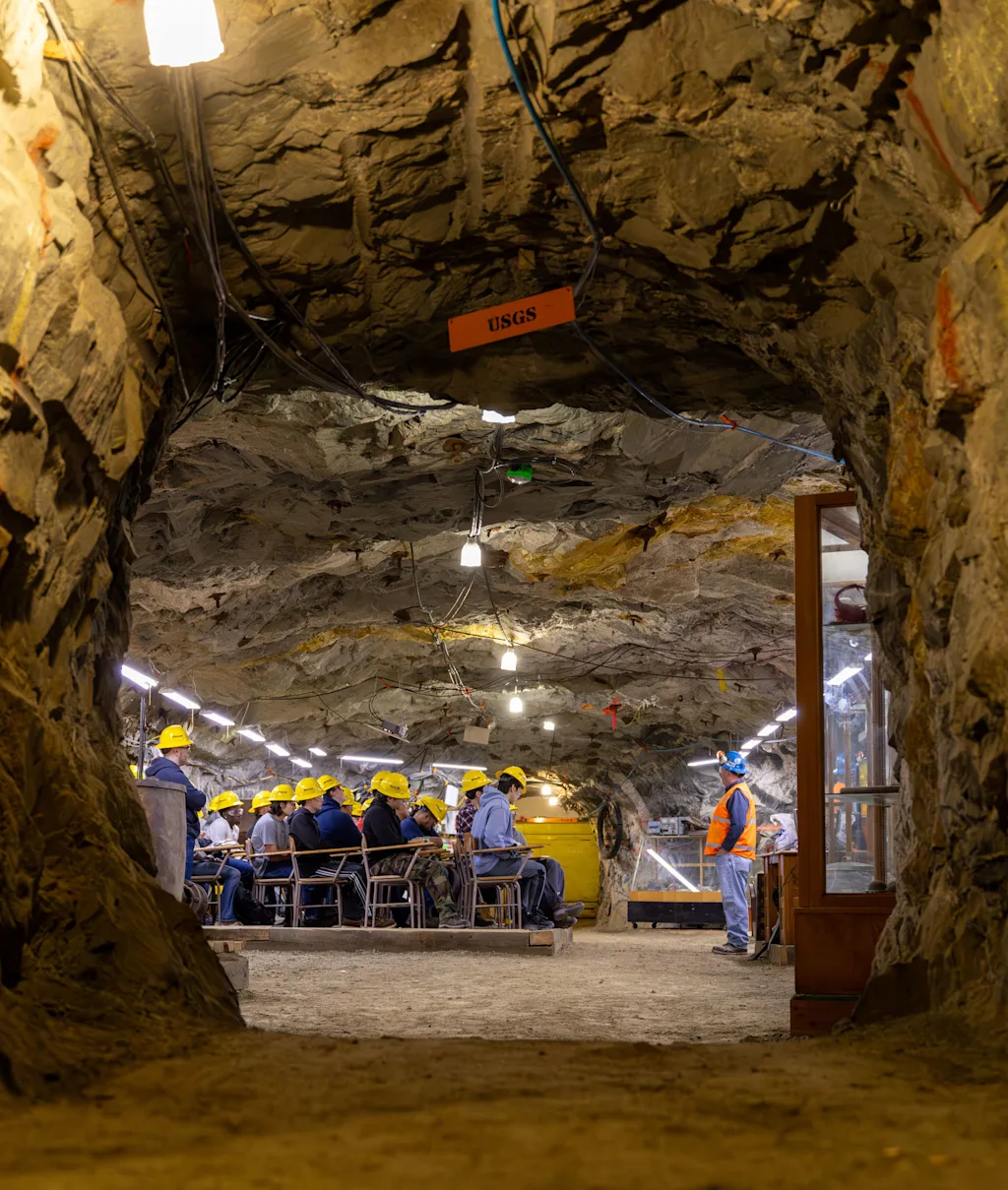
“Those programs started shutting down one after the other, because so much of the work was getting shifted abroad,” Columbia University professor Gadikota says. Other countries took advantage of that, and they started building up capabilities.”
Today, China has more than 38 mineral processing schools and more than 44 mining engineering programs, according to the nonprofit Center for Strategic and International Studies. China’s largest mineral processing program, at Central South University, alone has 1,000 undergraduates and 500 graduate students preparing for the field.
Now, schools and businesses are trying to spread the word that the mining industry has well-paying jobs to fill—and that mining today is different. Graduates in mining engineering regularly earn $70,000 and up, right out of school. According to the U.S. Bureau of Labor and Statistics, the median annual pay for mining engineers is $101,200. Specific expertise in the extraction of rare earth elements, for example, and a willingness to work in remote locations can boost compensation.
A new gold rush for mining engineers
From aluminum and antimony to zinc and zirconium, there are currently 60 “critical materials” on the U.S. Geological Service’s list, minerals and rare earth elements that are vital to batteries, semiconductors, planes, lasers, medical imaging devices, cancer therapies, cars, electronics, nuclear power plants, and more.
As defined by the Energy Act of 2020, these materials are “essential to the economic or national security of the U.S.; have a supply chain that is vulnerable to disruption; and serve an essential function in the manufacturing of a product, the absence of which would have significant consequences for the economic or national security of the U.S.”
Many of these materials exist in the U.S., but most of them are still stuck in the ground. That’s starting to change, as big mining companies and startups alike race to develop new domestic sources.
MP Materials, a rare earth mining and processing facility on the Nevada-California border, signed a guaranteed-pricing contract in 2025 with the Pentagon and saw its stock surge more than 240% for the year. MIT-founded startup Phoenix Tailings raised $76 million in venture funding last year, supporting the build-out of a next-generation rare earth processing facility in New Hampshire. In December, Ionic Mineral Technologies announced it had discovered rare earth and critical technology metals, including gallium, germanium, cesium, and tungsten, that it says are comparable to China’s deposits. Global mining giants like Glencore, BHT, and Rio Tinto are also developing critical mineral assets in the U.S.
Each of these companies employs its own mining engineers—and most of them also contract with other companies that employ them. The growth in critical minerals is creating new kinds of opportunities for young people getting into the industry. And schools are scrambling to revamp curricula to reflect the shifting industry landscape.
Kwame Awuah-Offei, who leads the Missouri University of Science and Technology’s Department of Mining and Explosives Engineering, says the school’s graduates typically fall into three career “buckets”: construction aggregate materials (a $35 billion-a-year business in the U.S.), mineral mining, and mining services (working for equipment makers, software companies, and others that support the mining industry). Even though U.S. coal mines still employ some 44,000 people, Awuah-Offei says, coal recruiters are having a tough go of it with new grads. “There is concern among students that if they want to have a 30- or 40-year career, it’s not in coal. Whether it’s true or not, the numbers have shrunk quite a bit.”
Interest in critical minerals is a big factor contributing to larger recent class sizes, Awuah-Offei says. Domestic need for resources is just in the news more—he mentions Trump’s talk of invading Greenland—“and it drives curiosity on the issue.” While undergrad mining engineering enrollment is still small compared with mechanical engineering, electrical engineering, civil engineering, and fast-growing nuclear engineering, it has grown over the past couple of years.
Awuah-Offei is confident that graduates will find jobs when they graduate—thanks to the new demand in rare metals mining and processing, coupled with “very strong job opportunities in the construction materials and aggregate side of the business.” The latter type doesn’t pay as much as metal mining jobs, but the attraction is that they tend to be around metro areas. “Lifestyle is an important factor for this generation of students,” Awuah-Offei says. “Even if a job in Bagdad, Arizona”—a remote copper mining hub—“is paying $10,000 more, they’d rather live in Dallas than be in Bagdad.”
“Things come in waves,” says Columbia University professor Gadikota. “We had a wave around climate. Right now we have a wave around metals and foundational materials.” Of course, the two things aren’t unrelated—which might be key to mining engineering’s widening appeal. Sustainability and social considerations increasingly define industry practices.
Mining meets AI, entrepreneurship, and environmentalism
“When people see today’s mining tech, they are surprised,” Awuah-Offei says. This includes not only massive excavators and tunnel boring machines, but also increasingly common autonomous trucks and robotic equipment.
Advances in technology have led to changes in mine design and operation, which in turn have created new challenges that require engineering-based solutions. “For example,” says Sebnem Düzgün, associate department head of mining engineering at the Colorado School of Mines, “one of my students recently analyzed problems with BEV [battery electric vehicle] operations in underground environments. It’s highly interconnected—there’s a societal need for these critical minerals, and mining itself also needs them, to electrify the mines.”

Düzgün recently led a recent curriculum update at the school, which included adding classes in things like data science, AI and machine learning, robotics, and autonomous operations. “All engineering departments have an industrial advisory committee,” she says, “and we frequently reflect their requests in our curriculum.” Modern mining involves using AI models to analyze geological and satellite data during the exploration phase, deploying predictive analytics to improve mine traffic flow and minimize equipment downtime, and creating digital twins to process real-time sensor data and optimize processes.
“If you go to the control room of a modern mining processing plant, all you see is big banks of computer screens with someone monitoring data streaming in from sensors,” Awuah-Offei says. “They don’t necessarily need to walk out there to see what’s going on.”
Technology has enabled a new breed of mining startups to flourish, which has prompted another change to the traditional curriculum. “Mining is mainly governed by large industry,” Düzgün says. “But as new businesses have emerged, we’ve started incorporating entrepreneurship into our curriculum, and now some of our graduates are entrepreneurs.” Some technology-enabled mining startups are even being funded at levels typically associated with AI companies. In January 2025, KoBold Metals, an AI-powered U.S. mining startup backed by Bill Gates and Jeff Bezos, raised a $537 million Series C round.
Another part of the mining engineering syllabus is environmental stewardship. “To be honest, we’ve been incorporating the social and environmental aspects of mining—things like mine closure and reclamation issues—into our curriculum for almost 20 years,” Düzgün says. “But the industry’s handling of these concepts became more pronounced.”
At Columbia, Gadikota says the mining program had morphed into earth and environmental engineering as the public became more focused on mining’s environmental footprint. ”We went so much toward managing environmental impacts that it reached the point where we didn’t even want [mines] in our backyard.”
Now, the pendulum is swinging back. “We are rediscovering and repurposing our mining roots and bringing back all of that knowledge, but not just in the same outdated manner. We need the metals. We also need to clean up the tailings”—materials left over after ore has been extracted from rock—“and the emissions, and develop sustainable water systems. We want to be conscious about managing tomorrow’s liability today,” she says.
Gadikota oversees a sponsored research agreement, announced in November, between Columbia University and Locksley Resources, which is targeting rare earth elements and antimony (used in energy storage) in California. Students at Columbia will explore approaches including AI-driven ore analysis, innovative electrochemical recovery, and carbon-dioxide-assisted mineral processing to help the company develop sustainable practices that improve upon current methods.
“If we wanted to build metal recovery capabilities based on technology that exists in other countries, we can certainly do that,” Gadikota says. “But we know that some of those mining pathways are not as energy-efficient, they’re not as material-efficient. They contribute to a lot of emissions. Then there is the processing side. How do we process the material in a way that allows us to produce not just one product, but multiple co-products? And how can we lower the environmental footprint of doing that? These are all key factors to consider, and that’s why we do what we do.”
Government spends heavily, but gaps remain
Last March, President Trump signed an executive order, “Immediate Measures to Increase American Mineral Production,” that outlined numerous steps to increase funding and cut red tape for domestic mining and metals processing projects. The government responded: The U.S. Department of Energy announced in August that it would issue nearly $1 billion in funding to advance and scale mining, processing, and manufacturing technologies across critical minerals and materials supply chains.
Three months later, the Energy Department’s Office of Fossil Energy announced that it would provide up to $275 million to build U.S. industrial facilities capable of producing valuable minerals from existing industrial and coal byproducts, and $80 million to establish “Mine of the Future” proving grounds to test next-generation mining technologies.
But there hasn’t yet been much federal funding specifically earmarked for mining education. “We’ve seen an uptick in research funding for faculty to go after,” Awuah-Offei says. “Traditionally, when there’s a lot of funding, universities are more willing to hire people in that area. So that has been good. But apart from programs in some states, like Texas, there hasn’t been direct investment in education, necessarily.”
Introduced in the House of Representatives in March, the Technology Grants to Strengthen Domestic Mining Education Act of 2025 (aka the Mining Schools Act) would establish a grant program to support schools in recruiting and educating future mining professionals, including engineers. It is currently awaiting action by the House Committee on Natural Resources. “Most of us support that because it will put direct funding into schools,” Awuah-Offei says. “Training mining engineers is expensive. You have to have an experimental mine. It’s lab-based and hands-on.”
There’s little time to waste. “We’ll work on cute little mining projects,” Gadikota says. “But if you want to scale them up and you need a domestically trained workforce to implement and grow them, does that workforce actually exist? The answer to that question is: We are behind, and we are doing everything that we can to develop that talent and get them out again.”
Discover more from The Veteran-Owned Business Blog
Subscribe to get the latest posts sent to your email.

You must be logged in to post a comment.