If you’re a Slack user, you’re probably familiar with Slackbot as a good-natured—if annoying—assistant that delivers notifications, reminders, and keyword-based automatic responses within the workplace chat app.
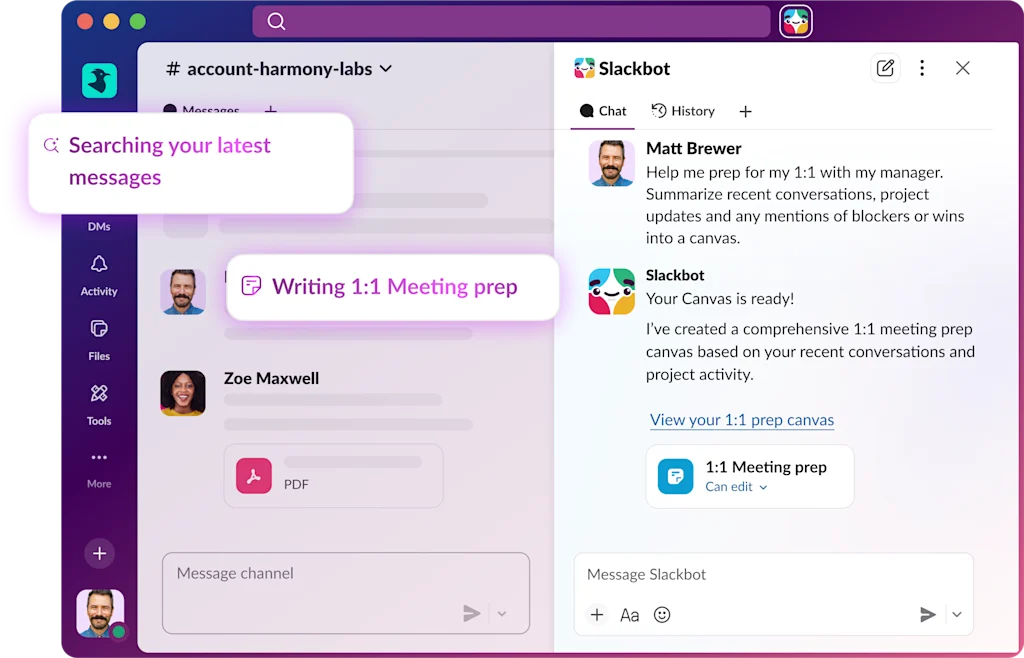
But for organizations with paid Slack plans that have AI features enabled, Slackbot is receiving a bit of a brain transplant. The company has rebuilt the humble bot as an AI agent that can help bring you up to speed on workplace discussions and priorities, pull in data from other software your organization has integrated with Slack, help draft reports and Slack canvas documents, and even help schedule meetings with your colleagues.
It’s part of a push by Salesforce-owned Slack to move from being simply a tool for chatting with colleagues to a hub for coordinating with both humans and bots. Slack already supports more than 2,600 third-party apps, and the new Slackbot is expected to increasingly integrate with specialized AI agents and software tools.
“The way that we think about Slack today is as the conversational interface, if you will, for what we call the agentic enterprise, where humans and agents are all working fluidly and seamlessly together to get work done,” says Rob Seaman, Slack’s chief product officer and interim CEO.
Already, Slack has offered AI tools to help craft canvases, the app’s freeform collaborative document format, and search through data in connected software like Google Drive, Box, Microsoft Teams and, of course, Salesforce. And now, users will be able to send plain language requests to Slackbot, similar to the kinds of inquiries handled by general purpose AI tools like ChatGPT or Google Gemini.
Slack isn’t the only company giving its chat-powered tools a dose of AI smarts. Amazon has developed a generative AI version of Alexa, Apple has announced plans for a supercharged Siri, and AI providers like OpenAI and Anthropic regularly update their bots with upgraded language models. And office suits from companies like Microsoft and Google have also integrated chat-powered AI tools.
But a powerful advantage of using Slackbot, says Seaman, is that it can harness retrieval-augmented generation—the technique of giving AI contextual information to help it answer specific questions—to act as a personal agent based on information already stored in Slack or linked apps. “We think that that deep organizational context is really what makes us immensely powerful,” Seaman says.
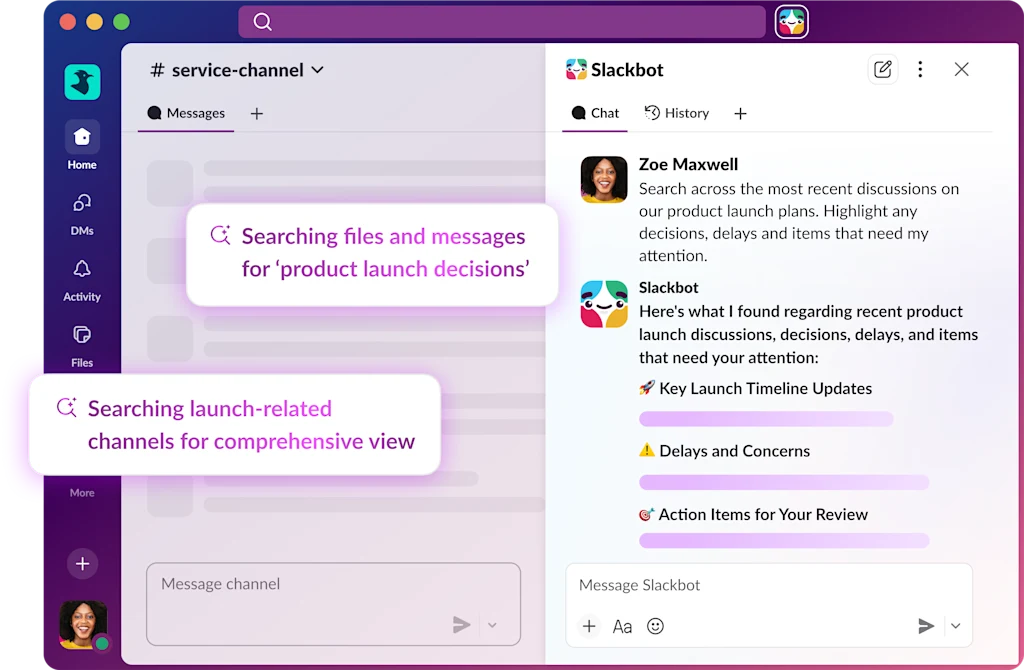
Another advantage is simply that the bot is accessible through Slack, meaning users won’t have to toggle between apps as they chat with coworkers and with the bot. Still, talking to the bot will be a bit different from querying a colleague: Slackbot is designed for users to interact with it one-on-one through a dedicated app panel rather than inside Slack channels or multi-person conversations, though users can collaboratively edit bot-generated materials like canvases.
Already, the tool has found widespread use at Slack and Salesforce, along with around 50 other organizations who’ve been given early access. Seaman says Slack product managers have used the new Slackbot to synthesize information from Slack channels gathering feedback on product features and ultimately turn that information into drafts of documents like sprint planning materials or meeting agendas.
The bot can also create documents in the style of an individual user, though Seaman says it’s sometimes helpful to prompt it to use, say, a more formal tone than what the bot can model after informal Slack discussions.
Like Slack’s other AI tools, Slackbot only has access to what a particular user already has permission to access in Slack and connected apps, which means companies shouldn’t have to rethink privacy settings when the bot comes online. The software will begin with access to a limited set of external tools, including some calendar integrations, though more are likely to be added soon, including support for scheduling calendar events. It also doesn’t have the ability to search the web, though Seaman says that’s also in the works for the near future.
And for organizations with old school Slackbot customizations, whether those are weekly reminders to clean out the office fridge or keyword-triggered reminders of the guest Wi-Fi password, those will remain available, Seaman says, though they’ll be sequestered from the new Slackbot in Slack’s interface.
“We’re going to move those notifications over into Activity and out of Slackbot, and then that way, Slackbot becomes this dedicated, personal agent,” Seaman says.
At Salesforce, the majority of employees are already regularly using the new Slackbot, says Ruth Hickin, VP of workplace innovation. Salespeople can save hours every week using the tool to quickly pull data for calls, rather than manually rooting around in documents, and other employees have been able to work with Slackbot to generate project retrospectives and future plans, she says. Salesforce staffers are regularly coming up with new use cases for the bot and, naturally, sharing them on Slack.
“We have 80% of employees using it, and they are coming up with use cases and sharing them internally,” she says. “And really with any new genAI tool, we do not know all of the impacts, so we can’t possibly know all of the great use cases.“
Salesforce workers have even started using the bot to help draft their annual employee self-evaluations, since it has ready access to information about what they’ve accomplished over the past year, says Ryan Gavin, chief marketing officer for Slack.
Discover more from The Veteran-Owned Business Blog
Subscribe to get the latest posts sent to your email.

You must be logged in to post a comment.