Vince Gilligan spent a decade ruminating about his next TV series before he had a clear vision of what it was going to be. But through all that time, the writer/director, who is best known for creating Breaking Bad and Better Call Saul, knew one thing for sure: it had to be entirely different from what he’d made before. In fact, it had to be completely unlike any other show, period.
“As far as a prime directive, it is always: A) how can we make this show look different than any other show on TV? That’s the most important one,” Gilligan told me during a recent call. “And B, how can we make the show look and sound and feel different from the other shows we’ve already done?”
Gilligan made good on his promise to himself. The resulting show, Pluribus, really is a wholly unique take on the sci-fi genre. Massive in scope, yet intimate at its core, it’s a deep study of a character who is going through an impossibly hard situation that affects the entire planet.
Before Gilligan told anyone about his idea for Pluribus, he wanted to get his idea onto paper. “I wait as long as I can, and I have as much figured out, at least with the first episode, as possible,” he says. “And in this case, I had the luxury of having a completely written first script, I think actually, possibly a completely written first two scripts.”

That’s what he showed to Rhea Seehorn, who played Kim Wexler opposite Bob Odenkirk’s Saul Goodman in Better Call Saul. Initially, Gilligan thought about a male protagonist for Pluribus but, after working with Seehorn, he decided to write the series for her. “I talked to Rhea first because I wanted to make sure Rhea would star in the show,” he says.
It was only after Seehorn agreed to play Carol Sturka—the grumpy bestseller romance author who becomes the hero—that he got the production ball rolling. “I started talking to our department heads, our wonderful crew people that I’ve been working with for years,” he tells me. “And that makes it a lot easier.”
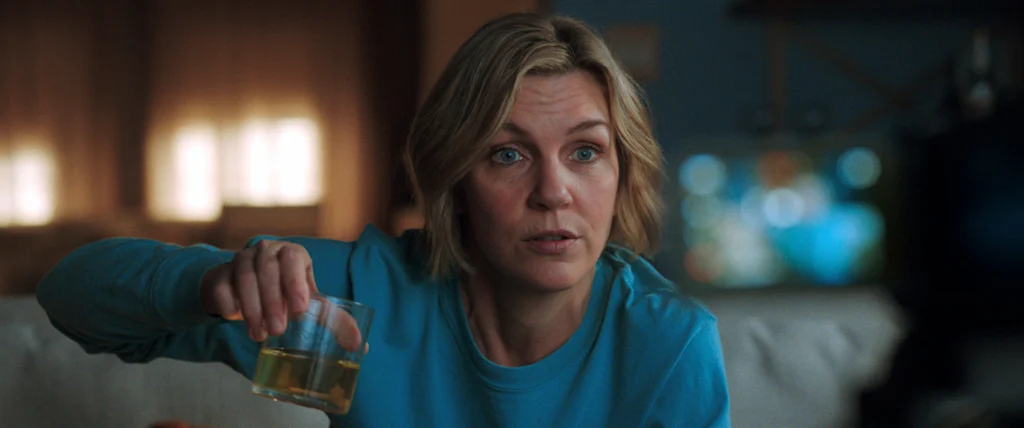
Gilligan—together with series’ writer/director Gordon Smith and writer Alison Tatlock—says the show’s premise is meant to be the opposite of every “alien invasion film” you’ve seen up to this point. Having first worked as a writer on The X-Files, which embodied and invented many of the universal sci-fi tropes, Gilligan knew that Pluribus needed to serve the premise with no cracks in the story, which resulted in flipping, subverting, and ultimately destroying every single sci-fi trope wedged into our collective mind since The Twilight Zone.
For Gilligan, Pluribus is the culmination of decades of work in TV. Filmed in Albuquerque (where most of the crew lives), Gilligan says the show is a direct result of working with the same reliable team he’s been with since Breaking Bad. Pluribus’ composer Dave Porter, who worked with Gilligan on his previous two series, told me that Gilligan’s directive cut across departments on Pluribus: “We wanted to plant our flag in the ground to say this is a very, very different experience.”
A Post-it sketch becomes a panopticon
To understand the production design, it helps to know what the series is about (my recommendation: run to watch the first episode if you haven’t yet). The series begins with an eerie but subtle alien encounter. The U.S. Army lab uses RNA code radioed from an exoplanet 600 light-years away to create a self-replicating alien retrovirus. The virus infects one person transforming her into the first node of a hive mind called The Others. Within a few weeks, all of humanity turns from a selfish, violent-prone, greedy group of individuals into a pacifist, vegetarian, and very happy collective.
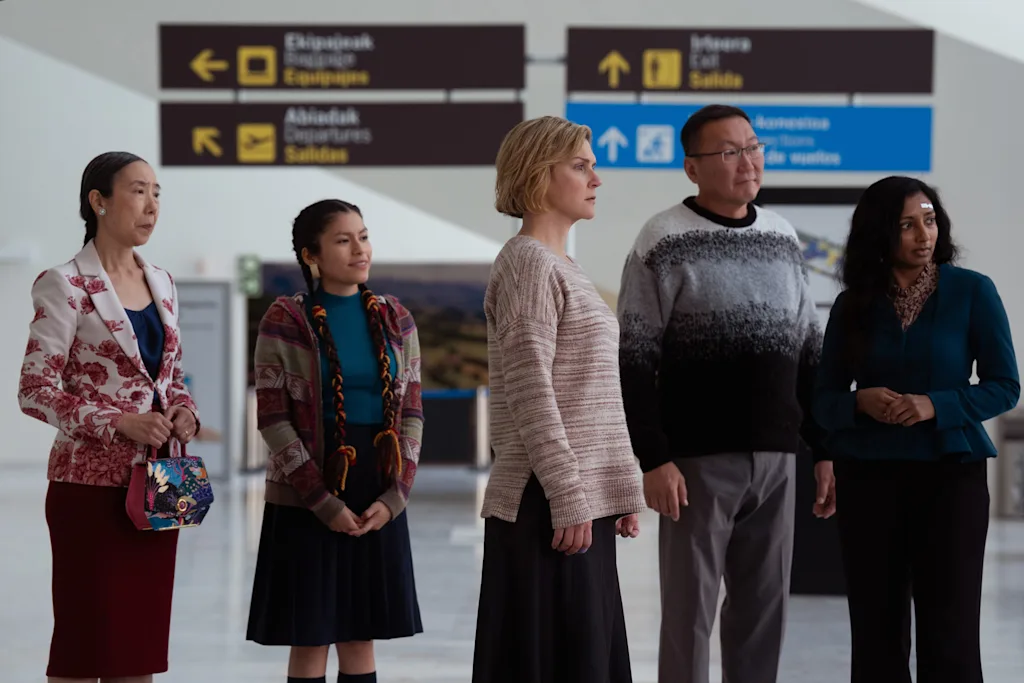
Immune to this alien virus, only 13 humans survive this process, called “The Joining.” Carol being one of them, is the only person in the U.S. that keeps her free will. The Others only have one mission: To turn civilization and the entire planet into a hippie bliss paradise, all while trying to find a way to “save” those last 13 humans from what they think is the angst of freewill, the pain of our daily choices, our imperfect nature. It’s not that they want to assimilate the 13 like the Borg or cordyceps; The Others believe they are doing the right thing when they liberate you from your sad pointless life.

Pluribus follows Carol as she grapples with this new reality, and as she tries to find a way to revert the world back to how it was. Carol has a mission, but her mission is far from a sci-fi trope of saving the world. There are no tropes in Gilligan’s vision. In fact, the series team had to strip away the spectacle usually associated with global cataclysms.
Smith and Tatlock describe this as a pursuit of “scrupulous emotional truth.” In most sci-fi, when the world changes, the characters sprint toward the explosions. In Pluribus, as it happened in Better Call Saul, they stop. “Your wife just died. Really? The world just became a hive mind, how fast do you move to get past that?” Smith asks.
This refusal to rush required a specific kind of geography and to ground the infinite scope of a global hive mind, led the production team to build a very small, very specific cage for Rhea Seehorn’s character. Her home is the center of her world.
That began with a crude drawing. “My favorite picture is a Post-it drawn by Vince,” production designer Denise Pizzini tells me. “He has a little cul-de-sac and he has these houses and he has the one house at the top that says ‘C’, which is Carol’s house.”
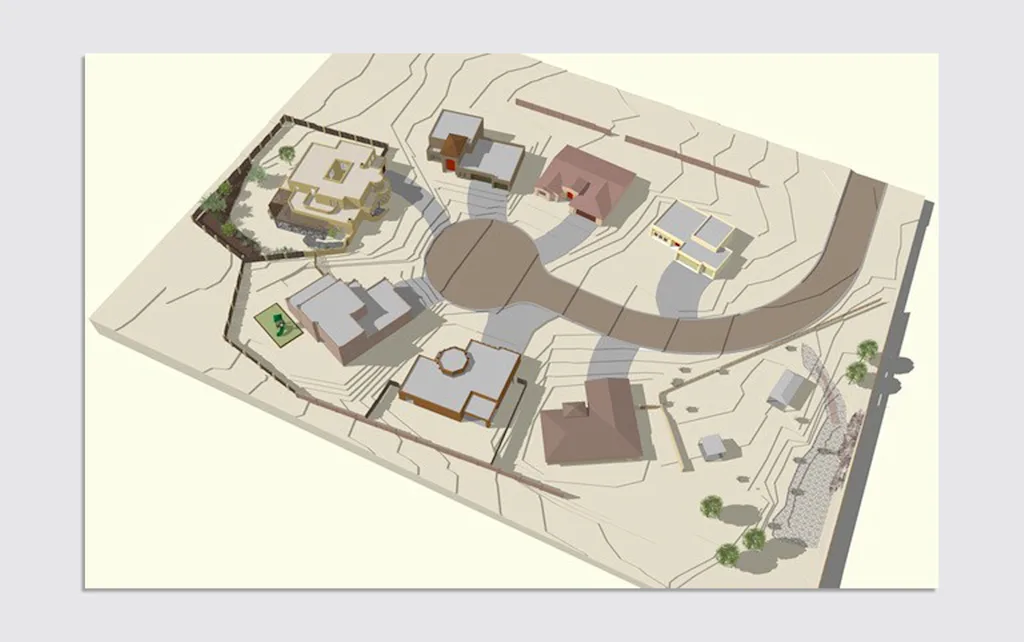
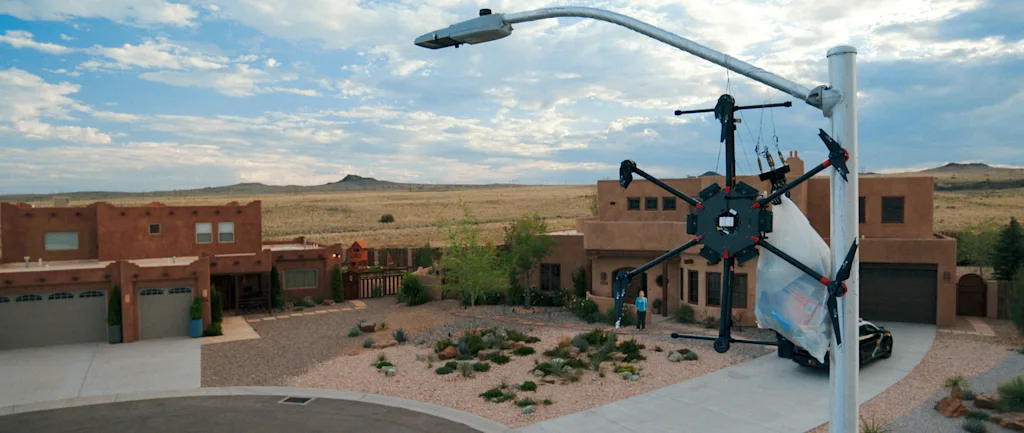
That doodle evolved into a big civil engineering project. Rather than fighting the logistical nightmare of filming in a real neighborhood for multiple seasons, Pizzini and her team leased a plot of empty land outside Albuquerque and built Carol’s cul-de-sac from the dirt up, complete with plans and full permits and licenses. They poured concrete slabs, laid curbs, and constructed seven custom homes around a circle of asphalt, which became itself a way to communicate later in the series (warning: some minor generic spoilers ahead).

A controlled gaze
The physical location of the house is real, with fully working systems and finished downstairs interiors. The team also built the upstairs bedroom, office, and hallways on a controlled soundstage. They duplicated the ground floor almost exactly, allowing the camera to seamlessly look from the street into Carol’s living room, or from her kitchen window out to the hive, without a cut, effectively building the house twice.

The architectural mirroring was so precise that the illusion eventually fooled its own creator. “I watched the episode last night, and there’s a shot of her in the kitchen seeing the exterior, and I thought, I couldn’t tell,” Pizzini confesses. “Is that on location or is that on the set? Which is great because I don’t remember.”
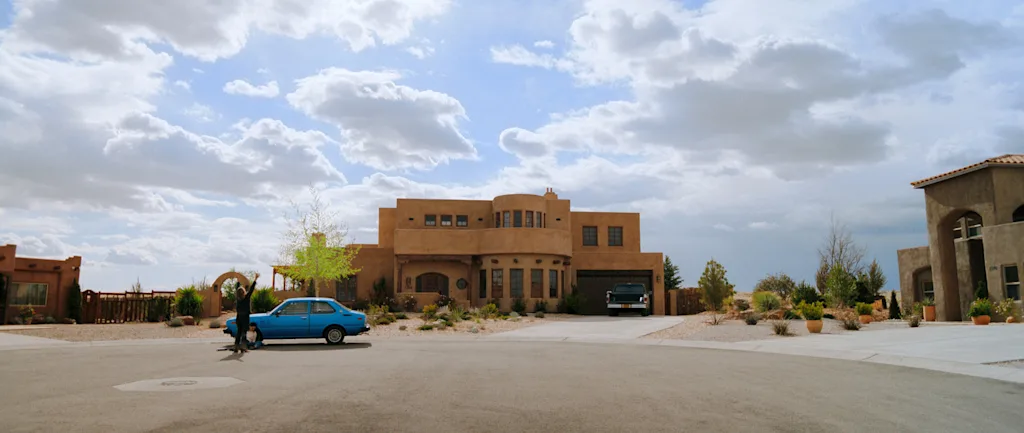
For Gilligan, this wasn’t just about production convenience; it was about the gaze. Before a single wall was framed, the team pounded stakes into the empty field so Gilligan could test the camera angles. “Vince was very specific about what we wanted Carol’s view to be,” Pizzini says. “We needed from her front door and that front window, we needed to be able to see everybody else’s front door. Plus the city lights below.” They even graded each house separately to ensure the street curved precisely to vanish into a fictional neighborhood.
The result is a set that functions like a panopticon, designed to ensure Carol is never truly alone. Pizzini designed Carol’s house as the “bastion of her humanity,” filled with the evidence of her previous life with Helen, who fails to survive the merging into the hive mind. The production team filled the space with invisible details. “Helen was [Carol’s] organizer . . . she manages all her tours,” Pizzini says. They placed Helen’s laptop on the dining room table, an orchid she bought, her sleeping mask, and her books by the bed. “Just little things like that give you an indication that they had a life together,” she says.

Pizzini also designed the interior knowing that this home was a character in itself. Inside, she used arches and open sightlines because so much of the action was going to happen there and they needed to move the camera around. “She’s in a little bit of a maze because she’s kind of stuck in her house . . . or she chooses to be,” Pizzini tells me. To show the passage of time, Pizzini added an atrium. “I decided to do this so there could be actual sunlight coming in. We could see the plants kind of growing or dying because Helen’s not there taking care of things.”

Gilligan was over the moon with the Pluribus set, he tells me, because it opened so many creative opportunities for them. They were able to design so many scenes in advance. “For episode one, when Carol’s coming home after this horrible night she’s been through, I wanted certain angles past her onto the house next door where the little kids [part of The Others] come out,” Gilligan says.

Carol’s home is a brutal contrast to the spaces controlled by the hive mind. As The Others consolidate, they abandon individual homes for communal living to save electricity and water. The world becomes austere. Traffic doesn’t exist. Lawns grow wild. Commercial spaces and offices are closed. Buffalos roam golf courses. Hospitals have the bare minimum personnel (remember, since the minds merged, everyone has everyone else’s knowledge, so every person regardless of age, gender, or previous occupation, is now the best doctor, the best pilot, the best physicist, and the best anything you can imagine).
Supermarkets are also empty. The production took over a real Sprouts supermarket after a year negotiating with the actual chain and weeks physically emptying the shelves. “Emptying out a supermarket . . . boy, that’s a nightmare,” Gilligan says. Sometimes you think something is going to be very complicated but turns out to be so easy. This was the contrary: They thought it was simple but it was a logistical hell, he points out. “Every step of the process, I was like, this is a nightmare,” Smith adds. Seeing the empty supermarket—and how it gets filled in a matter of hours—captures a society that has optimized itself into terrifying efficiency and silence.
Discover more from The Veteran-Owned Business Blog
Subscribe to get the latest posts sent to your email.


You must be logged in to post a comment.