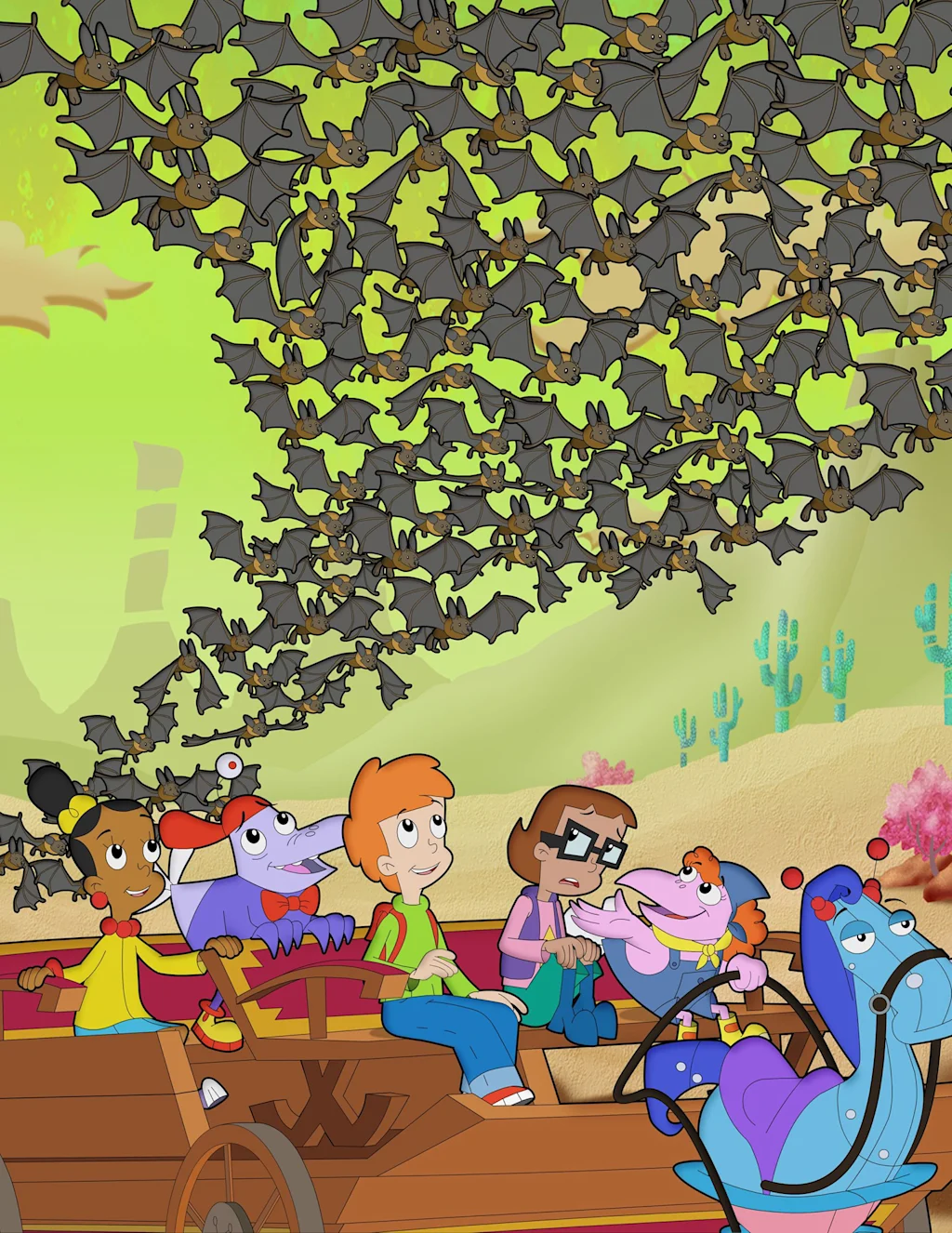
In the world of the long-running kids show Cyberchase, Motherboard, a sort of digital queen and literal technocrat, is the beneficent but impaired leader of all of cyberspace. She is—we are to understand—a legitimate ruler, yet faces constant attacks from the odious Hacker, a green-skinned android who dresses like a vampire and whose only goal is to sow chaos and eventually take control of Motherboard’s realm, which we might describe as something akin to a metaverse, or ever-expanding digital world.
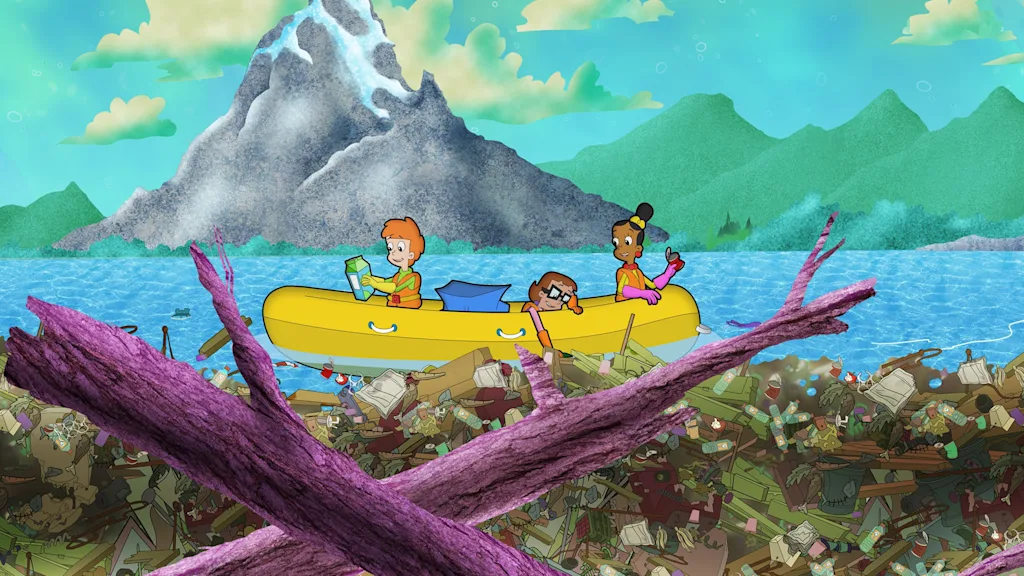
Luckily, a trio of human kids named Inez, Mattie, and Jackie—a squad—visit cyberspace frequently, where they embark on missions to help protect the ever-embattled Motherboard from her nemesis. They’re frequently assisted by Digit, a robotic “cybird” that guides them through various missions.
Cyberchase is a publicly funded STEM-themed program created by the public television channel WNET Thirteen. It’s been airing on PBS Kids since 2002. As such, every challenge the squad takes on can be answered with numbers, or at least some kind of mathematical concept. Sometimes, an episode involves a mission with subtraction, fractions, or even negative numbers! The whole point of the squad’s trials and tribulations is to teach children basic science, technology, engineering, and math concepts through adventures.
Sandra Sheppard, who created the show and now serves as executive producer, says its writers keep a close eye on how well U.S. students are doing with math concepts, especially as general math performance in the country continues to decline: Incoming freshmen at the University of San Diego increasingly need remedial math education, according to placement test performance, and national U.S. high school math performance has been sinking for years, according to the National Assessment of Education Progress. Parents report that social media continues to be a major distraction for kids.
In response, Cyberchase has adapted its content for the social media age, producing shorts that create snippets of its larger math lessons as well as online gaming content. For its upcoming season, slated to premiere in spring 2026, it has released its first seven-minute episodes, which are intended to find a midpoint between a full episode and short-form content.
Fast Company chatted with Sheppard about public television in the age of streaming and TikTok, the value of the PBS Kids brand, and how she’s adapting a beloved show’s math content to meet American kids where they are.
This interview has been edited for length and clarity.
I have a very particular memory of learning about negative numbers before everyone else, and then revealing this secret knowledge that I had learned through Cyberchase. But I didn’t have a smartphone or a computer with the internet until high school. How can you possibly get kids to the show when you’re competing with smartphones, chatbots, and TikTok?
Over the last decade, if not more, the approach to reaching kids is really very multi-platform, because we know kids are using multiple devices and watching in a myriad of ways. I think our partners at PBS Kids have been great in developing products and tools so that kids can really watch anywhere. Cyberchase is on the PBS Kids Video app and it streams everywhere, including YouTube. We also offer games, and that continues to be a really important part of the learning.
Thinking about getting our content where kids are watching is constantly on our mind, as is developing content for those platforms and experimenting on those platforms. That includes shorter-form content, vertical shorts, and different kinds of compilations.
Have you had more success with some platforms rather than others?
Probably most children watch our content on streaming. That being said, there still is a dedicated audience for linear broadcast. And it’s a very diverse audience. Across the platforms, full episodes continue to be the driver of engagement. That’s not to say short-form content isn’t popular, or compilations aren’t popular, but we find that kids are still really driven by story. A full episode is 22 minutes. We’ve been experimenting this coming season with seven-minute stories, a little more bite-size—as long as they’re a full narrative, so kids can have that kind of rich experience of watching a full story.
Can you talk a little bit more about the seven-minute episodes?
They’ll be coming out in March. It allows us to focus on math concepts a little bit more simply in bite-size stories, and really focus on some of the characters that we know our audience loves. There are Buzz and Delete, our bumbling henchmen who are buddies and semi-lovable in their own right. We’ve got a whole series of shorts that feature them in these kind of friendship-oriented adventures.
We can, in a short time, focus on a single strategy of subtraction, or focus on how to estimate using weight and why that’s an important tool. That’s not to say we’re moving away from long form, but it’s fun to experiment in that space. Those will be released digitally on all the PBS Kids platforms and YouTube.
How do you compete with the whole of the internet using algorithm-driven engagement when trying to get kids to your math-based content?
The PBS Kids brand is a very safe and trusted brand. For young children, parents, and families, we still guide many of their viewing experiences. And I think they see us as a trusted source of content. That’s not to say that there’s not lots out there and that it hasn’t become more fragmented. There are loads of choices.
How do you measure the sort of uptake of the ideas for kids? Is that something you study to make sure that they’re understanding math? How does that work?
We do a lot of initial developmental research, where we put ideas in front of focus groups of kids and families and test them out as early scripts. That gives us the opportunity to tweak up front. But we’ve also done a number of studies with external evaluators to really look at: Are kids learning the specific content in the shows? The good news is that we are really kind of a proven research model in that kids do learn from the series.
Something I’ve heard anecdotally from people I know who teach math is that kids seem to really be struggling. Especially after the pandemic, it seems like American students are really doing poorly in math. What’s the role of Cyberchase in that?
There certainly have been some national reports from the National Center for Education Statistics and the American Education Panel that have shown some real concerns in terms of math knowledge and gaps. Post-COVID, there have been some widening gaps.
Interestingly, in this season we made kind of a renewed commitment to focusing on topics like subtraction, which can be a complex topic for young children. For some, addition comes more readily. Subtraction, especially as a kind of mental map exercise, can be challenging. We are embracing topics that could use some extra support.
We live in a world that is changing. We’re all inundated with data, some of it AI-driven, some of it not. We’ve also focused in the last couple of seasons on data science, not only collecting and representing data, but looking at it and making sense of it reasonably.
Another topic that we’re tackling this season is fractions. I think that’s a topic that for a lot of kids takes a lot of reinforcement. Patterns are a foundational topic in math and a foundational topic in programming. Giving kids more exposure to patterns, all kinds of patterns, too.
I’ll say one other theme that I’m really excited about is connecting math to civics and the community. Certainly some of that involves data, but we have a very special show that’s going to be released called “Every Flipper Counts.” It’s set in this wonderful cyber site of Penguia where the penguins have to pick a new team captain for their belly bowll, and the squad comes in and they introduce voting as a fair way to decide. There’s a lot of math and figuring out how to set up a fair vote.
How have the cuts to public media impacted you?
As a station, we’re always looking at ways to be more relevant, more sustainable. We have some wonderful funders of Cyberchase who are very supportive. For decades, Cyberchase did receive funding from the National Science Foundation. And for the moment, that’s not happening. It’s a complicated time and we have to navigate a path forward and find new ways to be smart, be cost effective, and bring in new supporters.
Final question: Is Cyberchase the metaverse?
It is an imaginary cyber world. The metaverse term came later. It’s a whimsical, vast landscape of these wonderfully rich, imaginary cyber sites. It’s given us, as writers, an unbelievable place to go.
source https://www.fastcompany.com/91450169/cyberchase-pbs-ai-children-wnet
Discover more from The Veteran-Owned Business Blog
Subscribe to get the latest posts sent to your email.

You must be logged in to post a comment.