There’s something incredibly compelling about a brand-new year. A fresh start beckons, with each day untroubled by your past decisions. Whatever mistakes you made in 2025 are old news. They were sooo last year. You’re a new person now with new priorities, new habits, and new strategies. It’s in this spirit of new-leaf-turning-over that nearly a third of American adults—and almost half of 18- to 29-year-olds—decide to make New Year’s resolutions for the coming year.
Unfortunately, making resolutions doesn’t work. Baylor College of Medicine reported in January 2024 that 88% of people who make resolutions abandon them within two weeks.
That doesn’t mean change or improvement is impossible. It just means we’re going about it wrong each year on January 1 by declaring, “This year will be different!”
If you’d like to improve your finances, your health, your relationships, or any other aspect of your life in 2026, try some anti-resolution strategies for making the year great—since your resolutions probably won’t live to see Groundhog Day.
Why resolutions don’t work
Before choosing the best anti-resolution strategy for 2026, it’s a good idea to understand the psychological reasons why resolutions just don’t work.
One of the problems has to do with the fresh start the new calendar year offers to us. We are anticipating a “new year, new you” moment for ourselves, which often leads to unrealistic and overambitious goals. We love to tell ourselves the story that we could go from broke and couch potato on December 31 to frugal and running 5Ks on January 1 through willpower alone. This story doesn’t give us room for struggle, frustration, or failure.
Additionally, a New Year’s resolution is an external motivation. That decision to change comes about because the calendar is changing and not because of an internal push to change. This means that when the external motivation has disappeared—at about the same time Planet Fitness has stopped airing New Year’s membership deals 24/7—we’ve usually moved on, too.
Finally, we often make resolutions that require us to give something up. Financial resolutions ask you to deprive yourself of luxuries or conveniences, like streaming services or DoorDash when you’ve had a rough day. Health resolutions expect you to live without ice cream or fried foods indefinitely. While the intention behind these deprivation resolutions is good—saving money or improving your cholesterol levels—you can’t expect to white-knuckle your way through these losses for an entire year.
Humans are wired to be loss-averse, which means the pain of giving up things we like feels more intense than the pleasure we enjoy when we receive the same treats.
Unresolved in 2026
Looking at the start of a brand-new year makes me want to harness the excitement and enthusiasm of starting over with brand-new behavior. But I’ve learned over the years that I need actual strategies that will help me change my habits if I want to make lasting improvements to different areas of my life.
The strategies that work tend to have these things in common:
- The changes are bite-size. Rather than changing your entire life, you should focus on little habits you can adopt one day at a time.
- You leave room for imperfection. Pobody’s nerfect! And you will not pick up your new habit without mistakes, setbacks, and failures. Plan for them.
- You want to make the change. We often make resolutions that don’t really reflect our actual wants or motivations. But change happens only when we want it to.
- The change adds something to your life. Rather than making you feel deprived, habit change should offer some kind of benefit that you can name.
Here are the anti-resolution strategies that will make 2026 your best year ever.
2026 Bingo
In December 2024, instead of setting resolutions, I created a “2025 Bingo” board, after seeing several individuals on social media posting about the trend. For this gamified goal-setting exercise, come up with 25 different aspirations you would like to achieve in 2026 and fill a 5-square-by-5-square poster board with them.
Setting your 2026 intentions this way offers a number of benefits. First, it allows you to keep thinking about your goals throughout the year. For example, I ran a 5K in October of 2025, filling in that square of my bingo board very late in the year. Had I simply resolved to run a 5K in January, I would certainly have forgotten about it by fall.
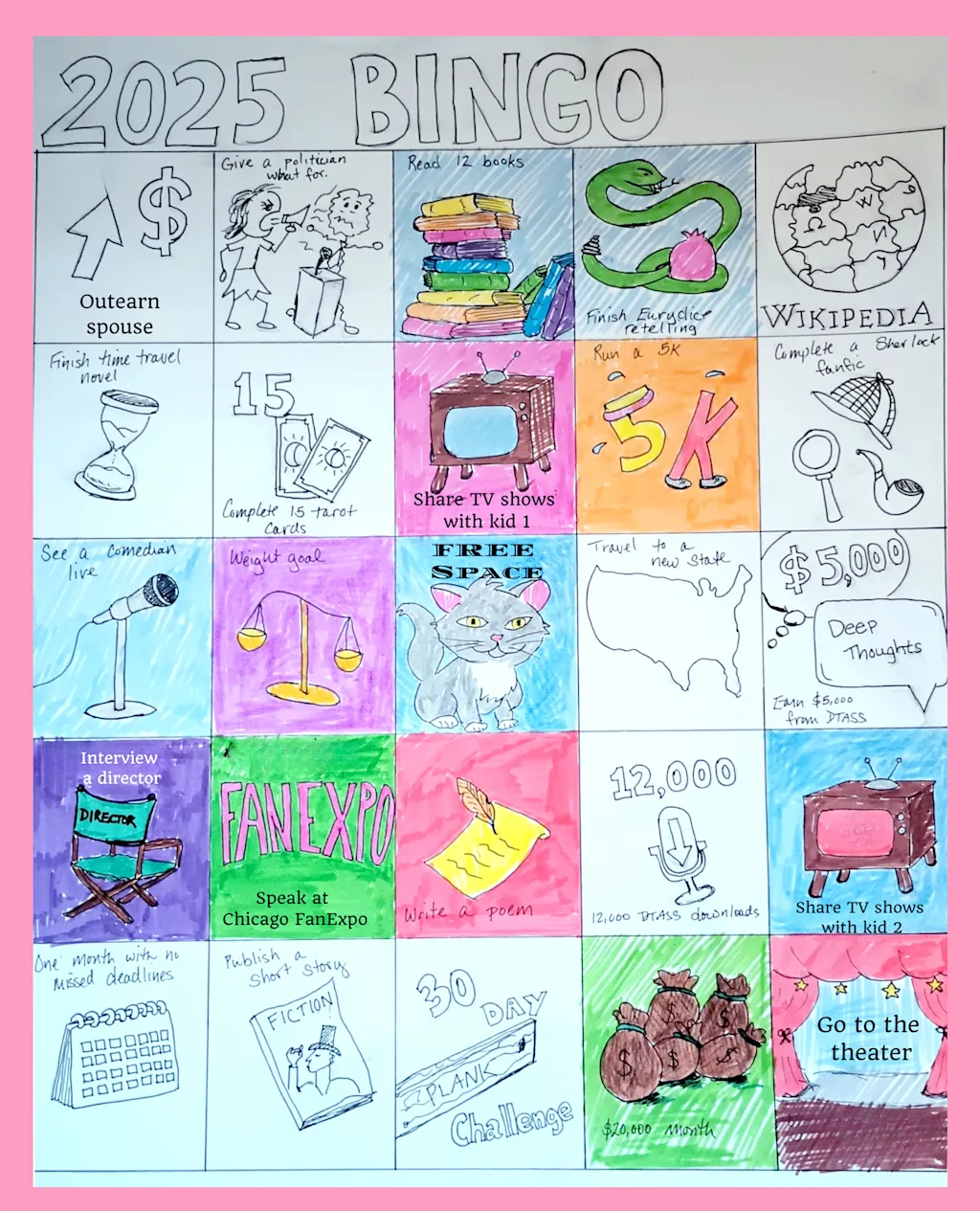
In addition, by giving yourself 25 spaces, you have room for audacious, silly, unrealistic, and embarrassing goals. While some of my goals were entirely within my control, such as running the race, going to the theater, and visiting a new state, there were other goals that I only had some control over, such as my goal for a certain level of income and my long-term goal to get a Wikipedia page. (Did I mention you can put embarrassing goals on here?)
If you decide to create a “2026 Bingo” card, consider giving yourself a free space in the middle, and aim for five in a row by the end of the year. Whether or not you make it, you’ll set yourself up to think about what you want and how you can get it—and you’ll have some fun with it.
Set monthly resolutions
Part of what makes a New Year’s resolution so daunting is the fact that you’re trying to make a change that will last for the entirety of 2026. But committing to a change for a single month is much more doable—and it can lead to long-lasting behavior change.
For example, studies show that people who take part in the annual Dry January sobriety challenge do not return to their former drinking habits after the month ends. Additionally, they tend to make long-term changes to their drinking habits and see sustained health benefits after taking part in just one Dry January challenge.
Start thinking about what you would like to tackle each month. Perhaps you might focus on paying down debt in January. February could be when you focus on your taxes. March might be about getting your retirement planning started.
Another benefit of this strategy is that you don’t have to decide all at once what your resolution will be for each month. As the year progresses, you can make new resolutions for each month as you reach them. And even though your focus may change from one month to the next, you can feel confident that you’ll reap benefits from each month’s focus long after it ends.
Find your 2026 mantra
You may have seen people talk about choosing a word for the year (often in the same corners of the internet where you might find people with unironic “Live, Laugh, Love” decor). The idea behind a word for the year is to choose a guiding idea—such as abundance, grace, or exploration—that you will use to focus your mindset for the year.
Health writer Tara Parker-Pope describes these as “nudge words” and says choosing one will nudge you toward positive change whenever you think of it.
But rather than a single word, you may find it even more helpful to adopt a phrase for the year that embodies the change you want to make. For example, if you are hoping to pay off debt, the mantra “Slow and steady wins the race” could be a regular reminder to keep making payments whenever you can.
Alternatively, the phrase “Progress, not perfection” could be a good mantra for someone who puts off contributing to their retirement account for fear of making suboptimal investment decisions.
And someone who is trying to save up for a down payment might adopt the mantra “Any amount of money I can set aside today is better than none.” Because even saving a couple of bucks consistently will add up over time.
Plan for all of 2026, not just January
New Year’s resolutions may feel good on January 1, but they don’t last. Not only do we make unrealistic and ambitious plans for ourselves with traditional resolutions, but we are also trying to make changes based on external motivation. No wonder the vast majority of resolutions fail before February.
To make changes that will really stick in 2026, your strategy needs to rely on bite-size changes that don’t require perfection and that add something beneficial to your life.
Creating a 2026 bingo card allows you to choose 25 goals—from the sublime to the ridiculous—and will keep you invested in your goals all year long. Setting monthly resolutions—similar to the annual Dry January sobriety challenge—makes it less intimidating to adopt new habits while reaping the long-term rewards. And choosing a mantra for 2026 can help nudge you to make the positive changes you want to see in your life.
Discover more from The Veteran-Owned Business Blog
Subscribe to get the latest posts sent to your email.

You must be logged in to post a comment.