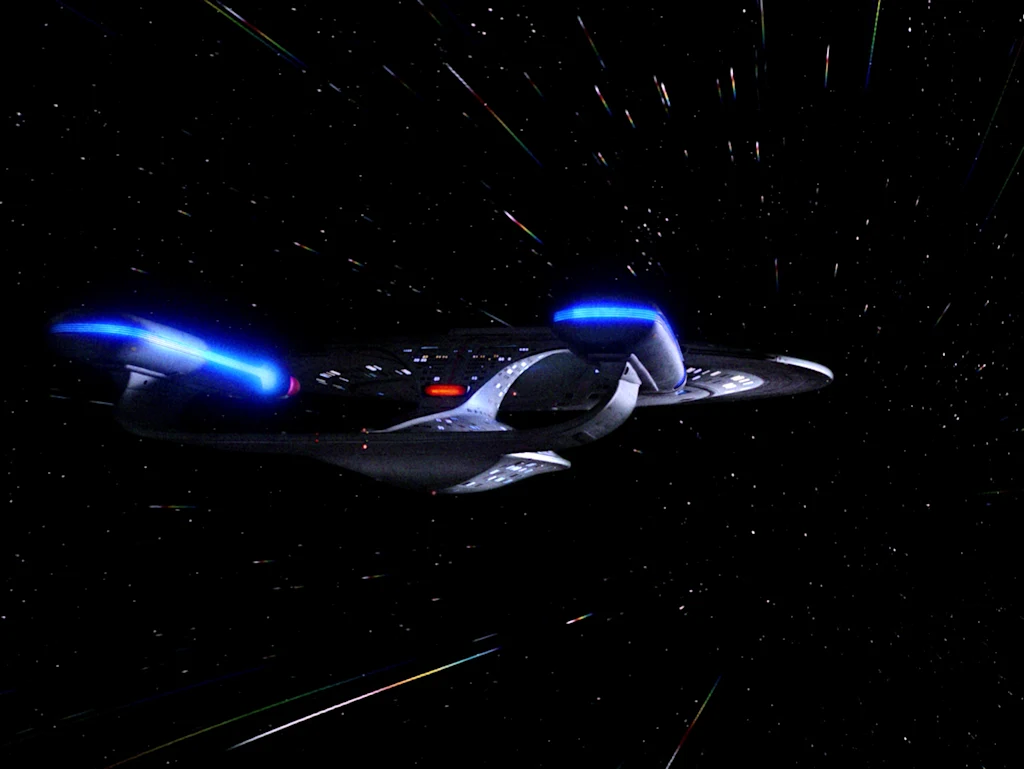
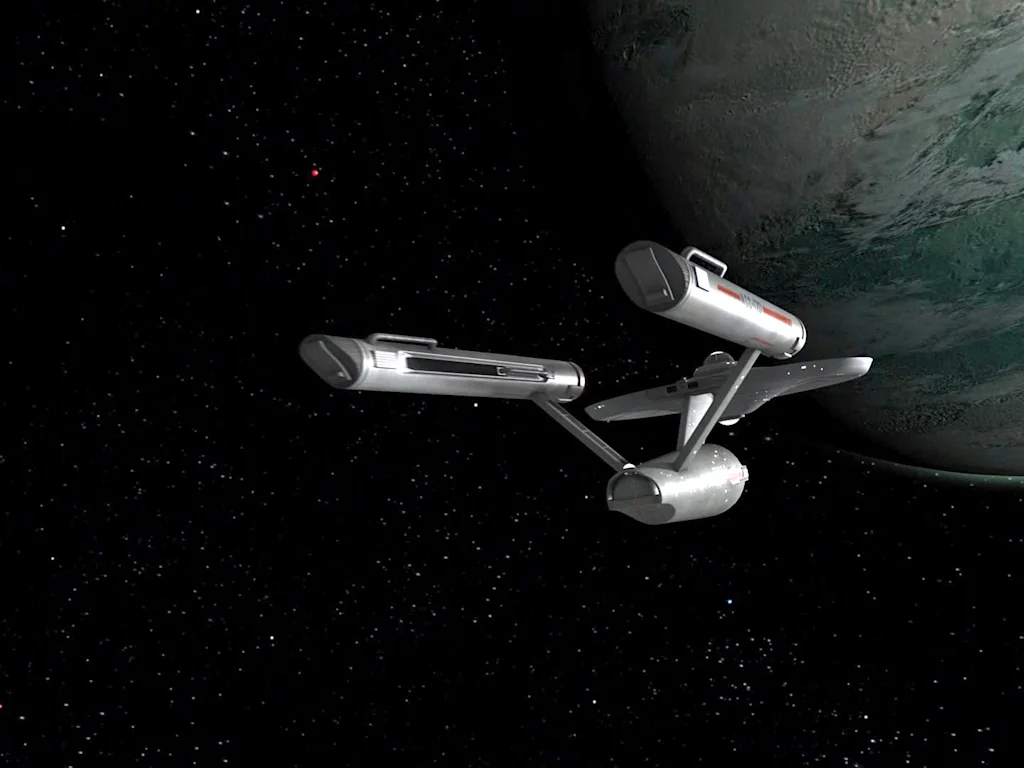
The USS Enterprise was an impossible dream rendered in fiber glass. Designed for Star Trek, it looked like a creation straight out of creator Gene Roddenberry’s imagination: Twin nacelles—those long, gleaming engine pods held by elegant pylons—extended from a central saucer holding the engines that allowed Captain Kirk, Mr. Spock, Dr. Bones, and the rest of the crew to travel across the cosmos.
Inside those nacelles, the show’s creators imagined, lay the secret that made those trips possible: a warp drive that could crease spacetime itself, folding the universe in front of the ship while unfurling it behind, allowing faster-than-light travel not through speed but through geometry. For decades, physicists dismissed it as beautiful nonsense—a prop master’s fever dream.
But now the math has caught up to the dream.
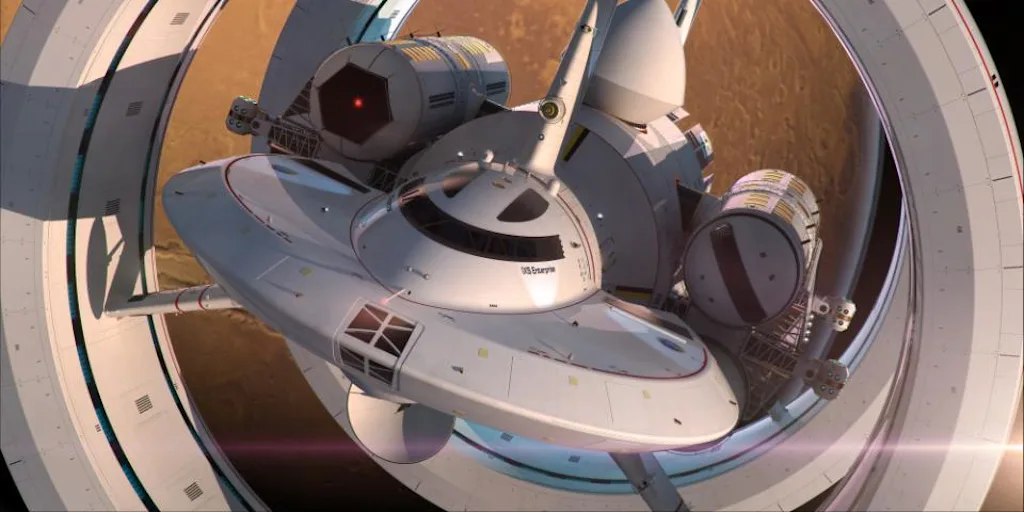
Harold “Sonny” White——a mechanical engineer and applied physicist who worked on warp drive concepts at NASA’s Advanced Propulsion Physics Laboratory—has published a peer-reviewed paper in the prestigious Classical and Quantum Gravity that proposes a new design for a warp drive that happens to look a lot like the Enterprise.
White told the science and tech publication The Debrief that “the resemblance to the twin nacelles of [Star Trek’s] USS Enterprise is not merely aesthetic, but reflects a potential convergence between physical requirements and engineering design, where science-fiction architectures hint at practical pathways for real warp-capable configurations.” In other words: When White and his research colleagues came up with a design that could bend spacetime but also keep a crew safe inside the ship, the optimal geometry that emerged was twin engine pods arranged around a central habitable zone.
That’s the Enterprise.
Perhaps it’s because there are only so many ways physics allows you to arrange exotic energy efficiently. Star Trek‘s production designers, working on pure intuition and ’60s aesthetics, accidentally landed on a rare optimal solution. It’s as if someone sketched the ideal car design in 1920 without knowing anything about aerodynamics, and a century later, physics said: “Actually, you were right.”
The warp drive
According to White and his colleagues, the original mathematical model for a warp drive envisioned a spacecraft encased in a continuous, donut-shaped ring of negative energy, a bizarre form of matter that works like gravity in reverse, pushing space apart rather than pulling it together.
Physicist Miguel Alcubierre proposed this model in 1994 after watching Star Trek episodes and wondering if the science could actually work. This theoretical geometry could effectively move an object faster than light by deforming the space around it, but his idea came with headache-inducing problems for any engineer trying to build it.
White’s breakthrough was simpler. Instead of trying to make Alcubierre’s donut-shaped design work, he asked a different question: What if you broke the energy ring into separate tubes, like engine pods, arranged around the ship? That small geometric shift—from one continuous ring to multiple discrete cylinders—changes everything about how the physics plays out inside the bubbles. The math suddenly became manageable. The interior could remain flat and safe. The dangerous forces could be confined to the nacelles, away from the crew.
“The results of this study suggest a new class of warp bubble geometries,” White explains. By organizing the exotic matter into these specific pods, engineers could theoretically maintain a completely flat, calm interior for the ship while the external geometry handles the violent warping of space.
But this research doesn’t mean we are going to be kirking and spocking all the way to the Crab Nebula any time soon. Faster-than-light travel remains a theoretical—but possible—way to travel across the cosmos that depends on many factors, like producing the fuel necessary to make it happen. If it ever happens, it will be generations away. White’s paper, however, provides a mathematical blueprint for practical design and engineering. Once built, his proposed design will result in something that looks like every nerd’s favorite spaceship.
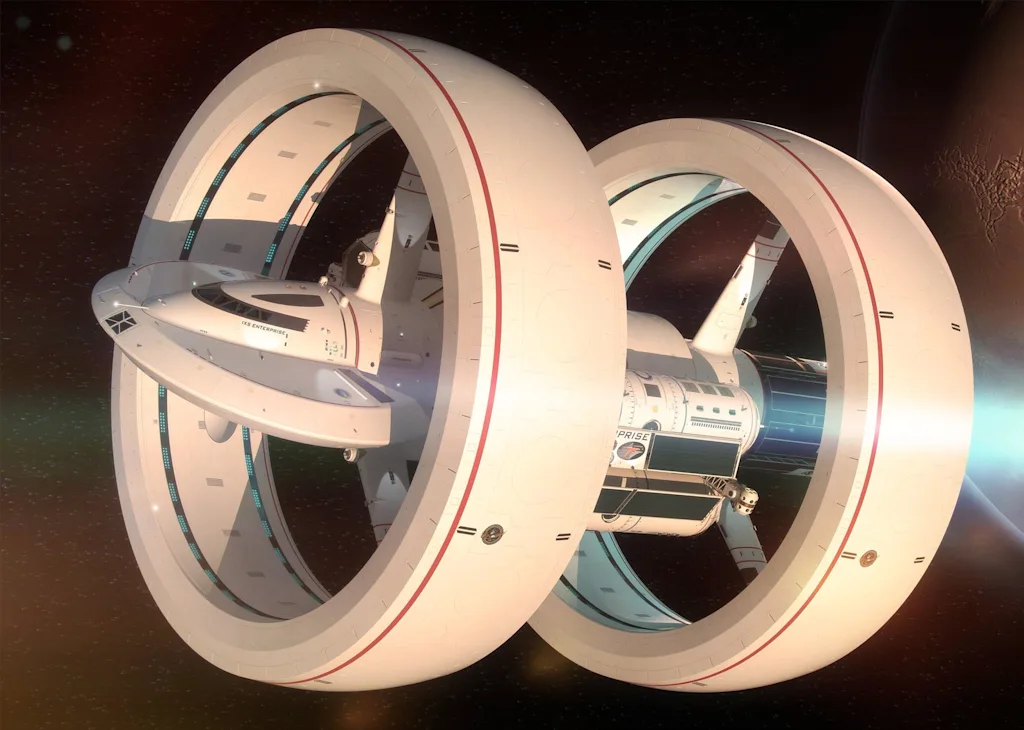
White’s math dictates that to keep the ship’s internal clock synchronized with the outside world and avoid ripping the pilot apart, the most efficient structure involves arranging these energy tubes around the craft—exactly like the twin nacelles of the USS Enterprise.
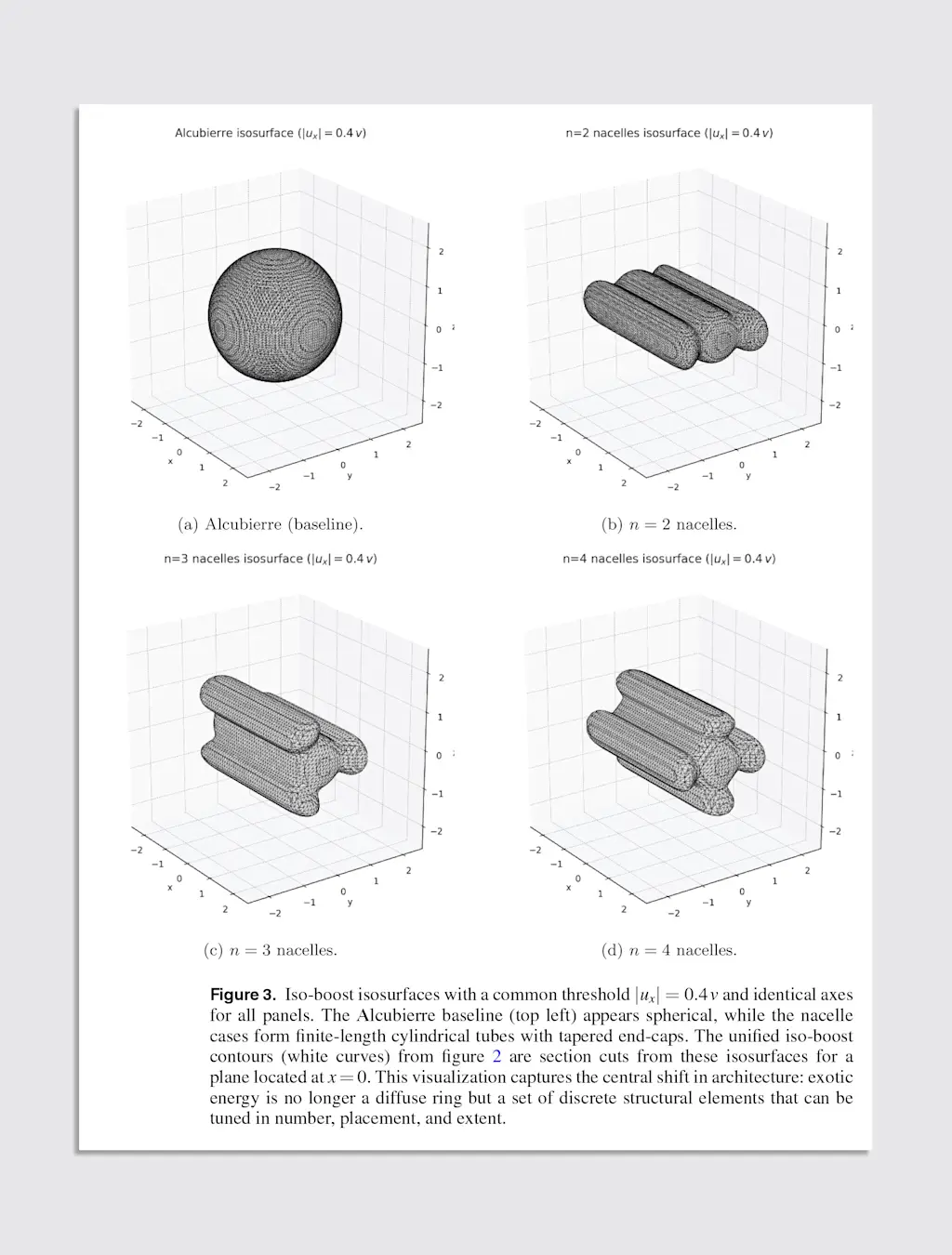
by White et al., 2025 [Image: White et al./CC-BY 4.0]
“I knew it should be possible to construct warp bubbles based on a nacelle-like topology,” White says, noting that the new geometry allows for structures that act as modular propulsion units rather than a single, unmanageable energy field.
Humanity’s hallucinations
This phenomenon of fiction functioning as a crystal ball/R&D lab for reality has pervaded civilization’s progress since Jules Verne’s predictions of moon trips and nuclear submarines. Take Ryan McClelland, a research engineer at NASA’s Goddard Space Flight Center, who found himself staring at the screen during the pandemic, watching The Expanse, a series that imagines a realistic scenario for humanity spread throughout our solar system.
“They have these huge structures in space, and it got me thinking . . . we are not gonna get there the way we are doing things now,” McClelland told me in a interview from 2023. That sci-fi binge-watch led to Evolved Structures, a project where McClelland uses generative AI to hallucinate spacecraft parts that look unnervingly organic—as if they were extracted from an extraterrestrial ship secretly stored in an Area 51 hangar.
The AI, unburdened by human preconceptions of what a bracket should look like, designs twisted, bone-like metal forms that are a third lighter than human designs but just as strong. McClelland believes it is the only way that we can mass manufacture the future of space colonization.
The translation from page to pad is often even more direct. NASA engineer Les Johnson became obsessed with the idea of laser sails after reading the novel The Mote in God’s Eye written by Jerry Pournelle and Larry Niven in 1974, which describes a sail that uses photons as a thrust force to move a spaceship over vast distances at extremely high speeds. It made him become an engineer.
“I had an opportunity to get involved in a project that was looking at different types of propulsion, and this is one that I added to the mix to consider,” he told me during an interview for a story on how he and his team designed the largest solar sail ever created. “Now the technology is here—we can build these things. And that’s been on again, off again part of what I’ve worked on for the last 20 years.”
The list of fictional technologies that are now mundane reality is so long that it is actually exhausting. Sometimes they take a handful of years to become real. Other times decades pass between the dream and the device.
In 1945, Arthur C. Clarke published a technical paper proposing geostationary satellites to relay communications; 19 years later, NASA’s Syncom 3 broadcast the Tokyo Olympics to the U.S., fulfilling the prophecy. Clarke was also to theorize solar sails in his 1964 story “Sunjammer.” Way earlier, in 1933, H.G. Wells imagined video calls on glass screens in The Shape of Things to Come; it took 87 years until the Zoom era made us sick of them.
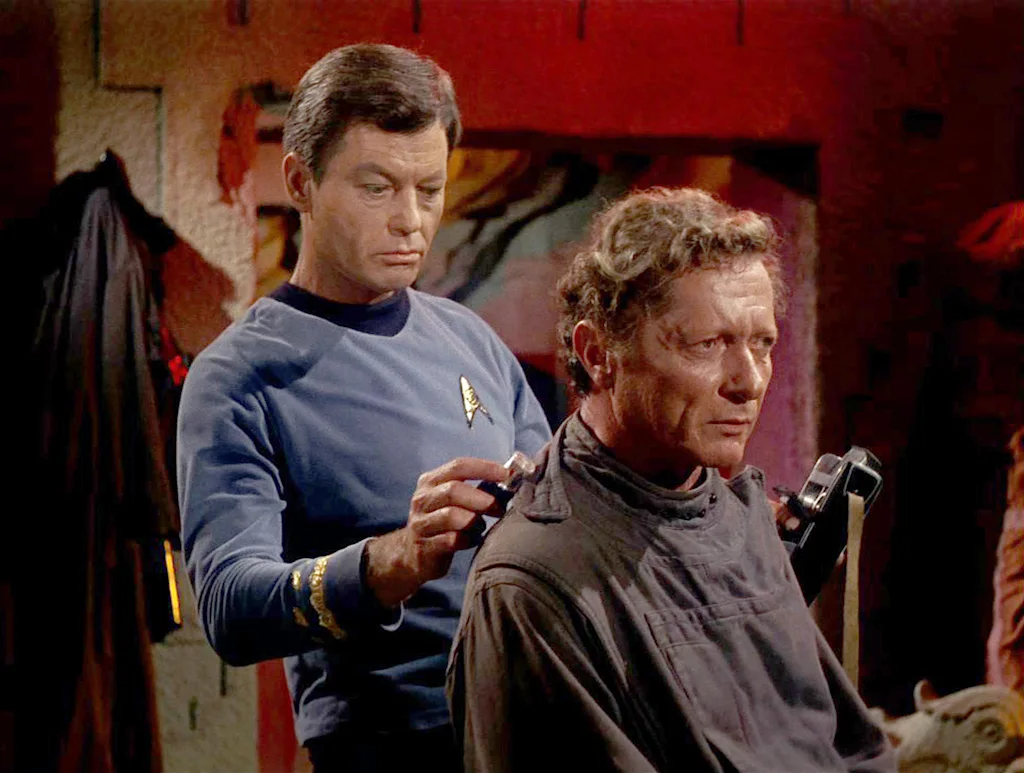
It’s not the first time this has happened with Star Trek. Saying that the series shaped humanity as we know it today is not an exaggeration. It introduced ideas that, many decades later, resulted in designs and technologies that have moved humanity forward.
Not just automatic doors, but mobile phones, touchscreen tablets and interfaces, voice-activated AI assistants, medical scanning devices, and virtual reality. Star Trek didn’t just predict the future—it became the blueprint engineers actually followed to design it.
Clearly, there’s a pattern here of dreaming up the impossible, putting it on a screen or in a book to entertain ourselves, and then, slowly but surely, our math and our machines evolve until they catch up to the fantasy. It feels like we are not just observing the universe; we are designing it to match the stories we tell ourselves, proving that the most powerful force in physics might just be a good writer’s deadline. Some scientists think we all may be part of a cosmic simulation in some alien computer. Perhaps we are all giant AI, like in Asimov’s short story “The Last Question.” Whatever the case is, the fact is that humanity seems to have a peculiar knack for reverse-engineering its own hallucinations.
source https://www.fastcompany.com/91458842/star-trek-enterprise-spaceship-physics
Discover more from The Veteran-Owned Business Blog
Subscribe to get the latest posts sent to your email.

You must be logged in to post a comment.