Hello again, and thank you for spending time with Fast Company’s Plugged In.
Last October, I visited the Silicon Valley headquarters of 1X Technologies—the startup behind a humanoid home robot called Neo—and spoke with its VP of product and design, Dar Sleeper. Among the points he made was that long-standing public expectations have set a high bar for household robots. Naturally, he name-checked the world’s most iconic one.
“The ultimate, North Star, in a lot of people’s minds, is Rosie the Robot,” he told me. “A Jetsons world where you ask and receive, and it makes your life better, you spend more time with your family, you’re more present.”
Sleeper’s reference returned to the front of my brain last week, when I attended a Wired event in San Francisco featuring an interview with Cloudflare CEO Matthew Prince. Explaining AI’s transformative impact, he turned to an obvious precedent: George Jetson’s reliance on Rosie.
”I keep watching reruns of the old cartoon show The Jetsons,” Prince said. “There are a lot of things that are anachronistic about it. But I think asking the question, ‘Where does George get his information from?’ is a really interesting one. And the answer is Rosie the Robot. When he says, ‘Hey, Rosie, I want a recipe for chocolate chip cookies.‘ Rosie doesn’t say, ‘Here are 10 blue links, go find one yourself.’ Rosie says, ‘Here’s a recipe for chocolate chip cookies.’”
Rosie comes up so often in discussions of the future of technology that it’s easy to tune out rather than nod in appreciation. But hearing two executives mention her by name got me wondering why this secondary character from a 1962 Hanna-Barbera prime-time cartoon, canceled after only one season (albeit rerun endlessly), has been such an extraordinarily durable touchstone. It’s not an easy question to answer. Even if, like me, you’ve already spent more time contemplating the Jetsons’ cultural impact than most people.
Before we go any further, a few Rosie factoids for you:
- Her name was originally spelled “Rosey,” but the more common “Rosie” won out over time.
- The very first Jetsons episode, “Rosey the Robot,” told the story of how she entered the Jetsons’ home, initially as a short-term rent-a-robot.
- She appeared in only one other episode among the 24 in the first season—that shocked me—but was much more prominent in the additional Jetsons shows Hanna-Barbera produced in the mid-1980s, including starring roles in the episodes “Rosie Come Home,” “Mother’s Day for Rosie,” and “Rip-Off Rosie.”
- As a sassy-yet-kindhearted maid, she drew undeniable inspiration from the title character in the newspaper comic Hazel, which had been turned into a popular TV sitcom the previous season. (The rest of The Jetsons knocked off another comics mainstay, Blondie.)
- Her Brooklyn-tinged voice was provided by actress Jean Vander Pyl, much better known as Wilma Flintstone.
- If you need to catch up on Rosie’s adventures, as I did for this newsletter, you’ll find The Jetsons widely available on streaming services—I watched the show on Hulu—and airing every day on MeTV Toons.
None of this explains why technologists are still talking about Rosie. The most superficial reason is that it would be pretty cool to off-load tedious household chores to someone else. Most of us can’t afford human help, making a robot maid an alluring proposition. (As shown in the first episode, even paying for Rosie was a challenge for Jane and George: She was a discounted previous-year demonstrator model, and they were able to keep her only because Mr. Spacely gave George a raise.)
But if all Rosie did was the dishes, I don’t think she’d be so well remembered. She is a piece of sophisticated technology with an uncommonly humane user interface. That’s why the Jetson family loved her so much, and why she sticks in our minds. And given that her features are presently morphing from fantasy into stuff that might actually be possible to build, she’s only growing more relevant.
As with many things about The Jetsons, Rosie is both old-timey and prescient. At one point in the first episode, she opens her front and dumps in Judy Jetson’s homework tapes to incorporate them into her knowledge base. Thankfully, magnetic tape petered out as a primary form of data storage well over 40 years ago. But Rosie’s ability to crunch Judy’s classwork—and presumably help her with it—sure looks similar to an LLM ingesting data.
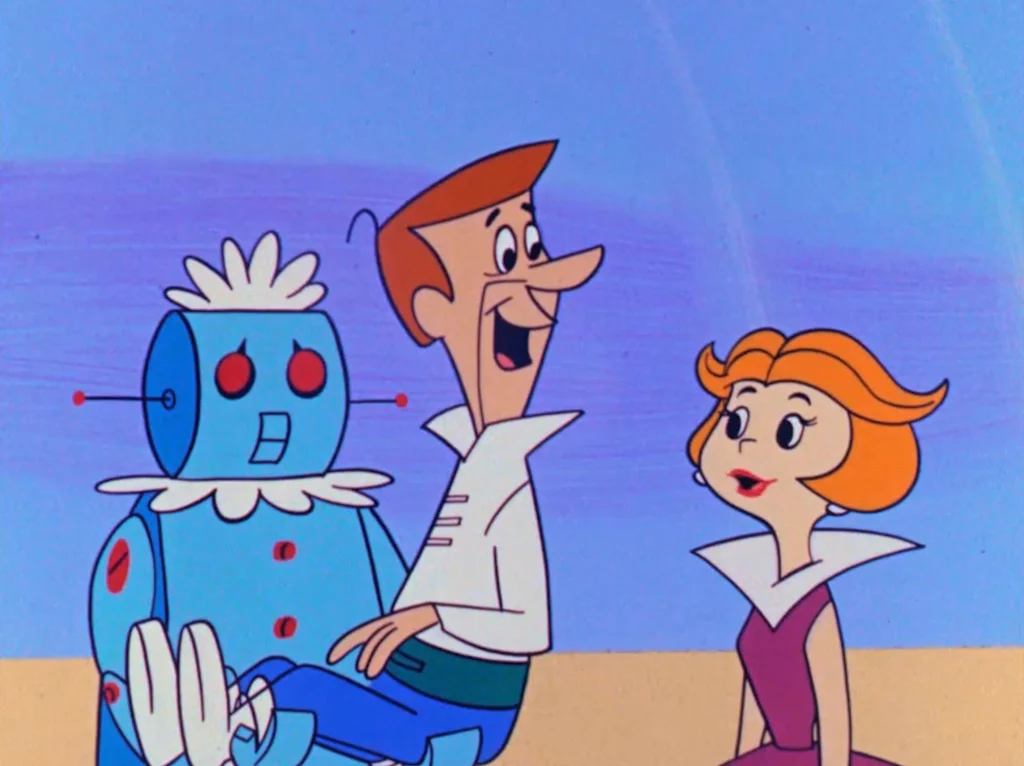
In today’s buzzwordy AI parlance, Rosie is also agentic. She handles tasks with a sizable degree of autonomy, is fine-tuned to behave responsibly and, though engaging and supportive, never slips into sycophancy. If Elroy confided that he was planning to become a juvenile delinquent, we can be certain she wouldn’t aid him. Instead, she’d push back on the idea and—if necessary—alert his parents. Our 2025 chatbots are crude by comparison, if not downright dangerous.
Still another reason why Rosie remains resonant is the timeless appeal of The Jetsons’ optimistic air. As depicted in the show, the future is a pretty wonderful place, and Rosie is part of that. Even by the end of the 1960s, our culture had grown darker. 2001: A Space Odyssey’s HAL 9000 may be as famous as Rosie, but he’s also a grim object lesson in the dangers of trusting technology to work in our best interest. You won’t catch tech execs speaking approvingly of HAL as a font of inspiration.
The Jetsons was never dystopian, but neither was it naive. A sizable percentage of its humor stemmed from the downsides of theoretically useful technology, often in ways that are, in retrospect, as forward-looking as any other aspect of the show. As you’ll recall, the end credits of every episode concluded with George becoming overwhelmed by a runaway automated treadmill and calling for Jane to “stop this crazy thing.” (In real life, Peloton’s safety issues with its Tread treadmill weren’t so funny.)
Rosie does not appear in another 1962 Jetsons episode called “Uniblab.” But its moral—that artificial intelligence in the office might be a pointless waste of money—is the furthest thing from entertainingly quaint.
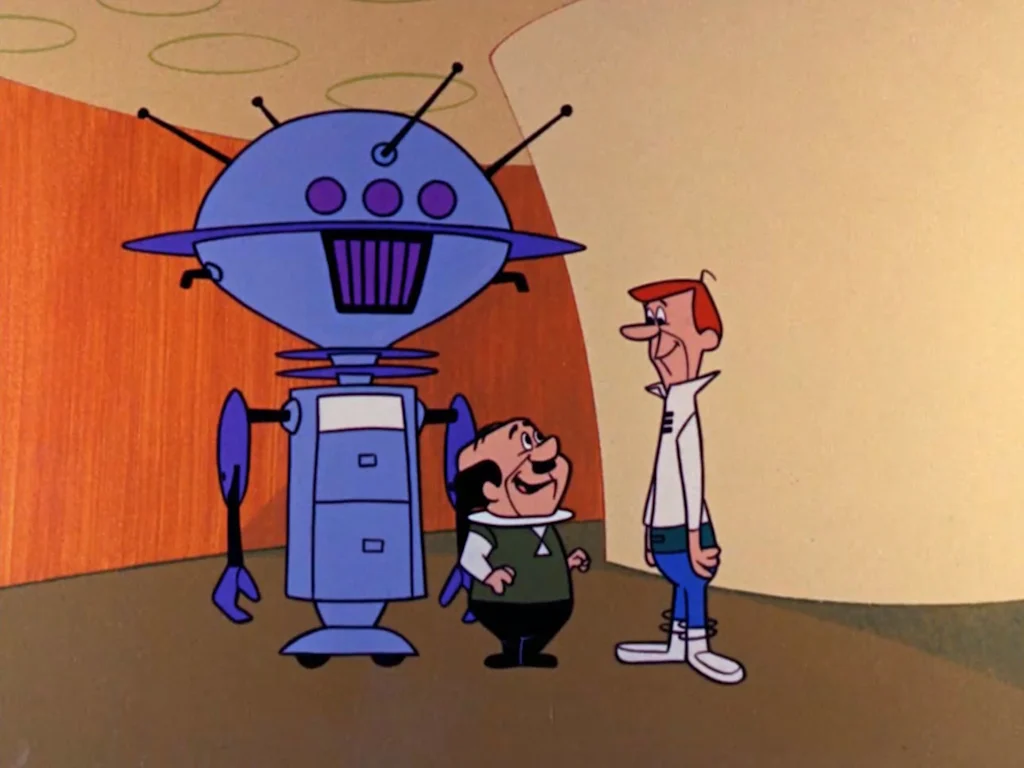
Uniblab is a workplace robot that Mr. Spacely acquires for $5 billion (!). Apparently an AGI true believer—he gloats that Uniblab has a higher IQ than George—Spacely demotes George to serve as the robot’s assistant. It turns out that Uniblab uses his always-on microphone to spy on Spacely’s employees. He also induces them to play rigged gambling games. And that’s about all he’s good for.
After being sabotaged by the show’s resident hacker, the Jetsons’ handyman, Henry, Uniblab suffers a hallucinatory meltdown in front of Spacely Space Sprockets’ board of directors. He’s unceremoniously decommissioned. Humanity triumphs, at least for the moment.
When The Jetsons premiered in 1962, publicity materials explained that it was set exactly 100 years in the future, in 2062. That indicates that even 37 years from now, AI may struggle to definitively prove its worth. For now, countless present-day Mr. Spacelys are currently overspending on the technology based on unrealistic expectations.
Rosie, meanwhile, is clearly based on more mature AI than Uniblab. But in the first Jetsons episode, Jane and other characters are astonished at her capabilities, a sign that domestic robotics will still be in the process of going mainstream in 2062. Which means that it may be several more decades until Rosie is truly, unquestionably real. May she continue to serve as an aspirational stretch goal for the entire tech industry.
You’ve been reading Plugged In, Fast Company’s weekly tech newsletter from me, global technology editor Harry McCracken. If a friend or colleague forwarded this edition to you—or if you’re reading it on fastcompany.com—you can check out previous issues and sign up to get it yourself every Friday morning. I love hearing from you: Ping me at hmccracken@fastcompany.com with your feedback and ideas for future newsletters. I’m also on Bluesky, Mastodon, and Threads, and you can follow Plugged In on Flipboard.
More top tech stories from Fast Company
The case only Netflix can make for buying Warner Brothers Discovery
Everything about its past suggests it’s the best future owner. Read More →
The Disney-OpenAI tie-up has huge implications for intellectual property
The House of Mouse is one of the most aggressive defenders of its IP. OpenAI literally just said it’d welcome erotica. What’s going on? Read More →
This startup is building a network of home batteries to help solve the grid’s woes
Haven Energy works with homeowners to install batteries and solar in homes that qualify for state incentives around areas where the grid is particularly overloaded. Read More →
AI is killing review sites. Can they fight back?
With AI replacing traditional search, review sites must evolve fast—or risk being cut out of the buying journey. Read More →
The Kalshi-fication of everything
The predictions platform is revealing what a world of total financialization will look like.
Read More →
OpenAI is clapping back at Google’s Gemini 3 with a new GPT-5.2
The new model displays expert-level skill in work tasks, and exceeds Gemini in several benchmarks. Read More →
source https://www.fastcompany.com/91457374/rosie-the-robot-jetsons
Discover more from The Veteran-Owned Business Blog
Subscribe to get the latest posts sent to your email.

You must be logged in to post a comment.