
To keep close to the startup community, I chat with founders often. I’ll frequently get asked about what growth is, how you apply it to startups, and when you should focus on it. So to help with those conversations, I put together a quick “Growth 101” doc to answer some of the most common questions I get from founders.
As a side benefit, my parents might have some idea of what I actually do for work.
What is Growth?
Growth is one of those silicon valley business terms that has made it into the general business lexicon, yet most people don’t know what it actually means. This is partially just due to the complexity and breadth of what a Growth function actually focuses on. To start, let’s talk about the traditional marketing funnel.
Below you can see what are called “pirate metrics”. This is because if you look at the first letter of each word it spells AAAAR (who said marketers don’t have a sense of humor?).
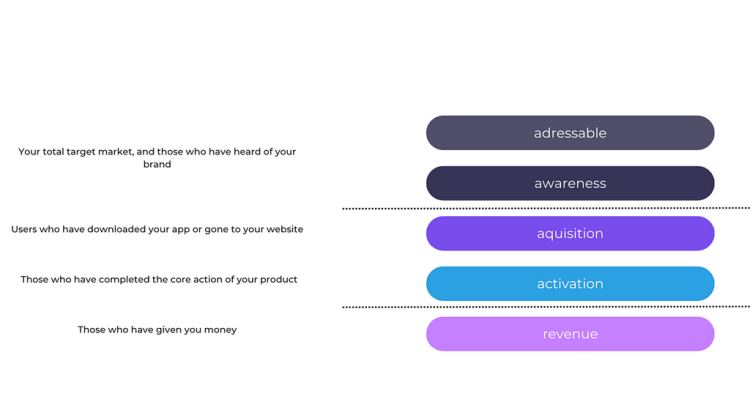
The normal way business function is by splitting these stages of a user funnel into different functions. Addressable, awareness, and acquisition are run by marketing or sales, and activation and revenue are owned by product. For bigger companies, this can be split even further, with each step of the funnel having a sub-team. The downside of this is that if you’re looking at each step individually, there is a tendency for user strategy to become very siloed, leading to a disjointed experience for the user.
That is where the concept of a Growth org comes in. Growth flips the idea of a siloed funnel on its head and instead focuses on the entire user flow as a whole. The distinction I like to make here is “Loops not Funnels”. (I got this concept from a previous boss I had at Cameo — thanks Evan).
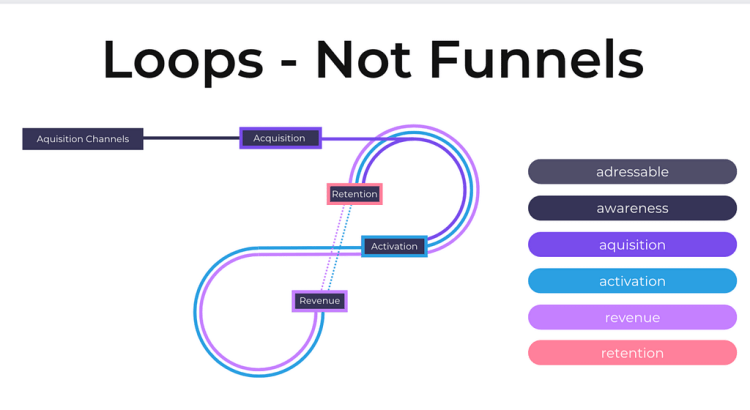
The idea here is that instead of thinking about moving a user down a funnel, you need to think about the user journey as a continuous loop. Once acquired (gone to your website or app), they continuously go through a loop of activating/failing to activate, giving you money/not giving you money, and then going through the process again and again (retention).
So what is growth?
A Note About Product Market Fit
Before diving into growth strategies, it’s crucial to address the concept of product-market fit. Product-market fit occurs when your product or service effectively meets the needs and demands of a specific target market. It’s notoriously difficult to measure, but when in doubt, I’m a fan of just using retention. When companies try working on growth before they have found product market fit, they risk spending time trying to build growth loops into a product that isn’t solving a problem well enough.
This is risky because it could cause you to continue working on a product that isn’t good enough yet, and because you’re wasting precious resources. Growth teams, pre-product market fit, will have a tough time scaling their efforts or getting their initiatives off the ground. Trust me; I’ve been there.
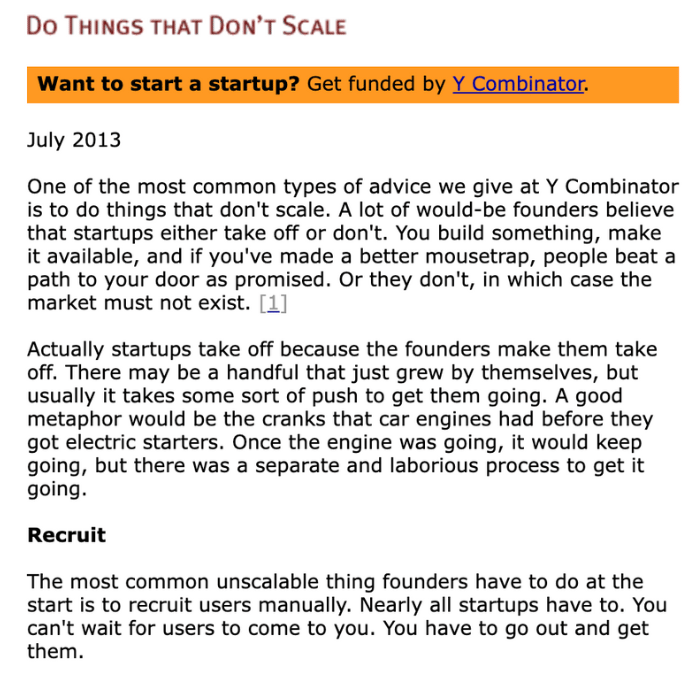
If you’re a pre-product market fit, focus on validating your product and getting users in non-scalable ways. There is a classic blog post written by Paul Graham called “Do Things That Don’t Scale”. I’ve attached a link in the image below if you haven’t read it. It talks about the insane things that the founders of AirBnB did at the beginning to validate their product and fix the problems that their initial users had. Clearly, it worked out well for them.
Types of Growth
I like to split Growth into three buckets, as seen in my over-the-top graphic above. As a rule of thumb, I like to tell startups to focus on going from left to right.
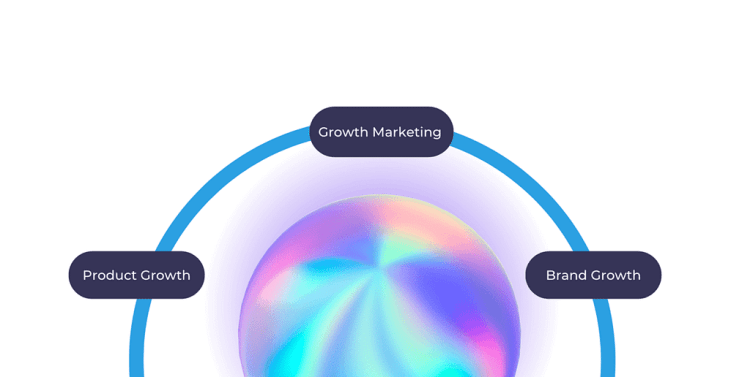
Begin with product-led growth. When you’re hitting your stride there, move to growth marketing, and then when you’re a mature company, work on brand growth (that’s for a later day).
Product Growth:
Product growth focuses on enhancing your offering to attract and retain customers. This involves continually improving your product based on user feedback and market trends. You can increase customer satisfaction, engagement, and loyalty by iterating and adding value to your product. Constantly seeking ways to innovate and evolve your product will fuel long-term growth.
Some types of product growth are things like conversion rate optimization and referral programs.
Conversion rate optimization
This involves optimizing your website or app to increase the percentage of visitors who take desired actions, such as making a purchase, signing up, or submitting a form. By conducting A/B tests, analyzing user behavior, and refining your user experience, you can systematically improve conversion rates, driving growth without necessarily increasing traffic. This is a great way to tweak your product to ensure it’s as effective as possible before pouring more traffic in.
Some typical places to work on conversion rate optimization can be seen below.

Referral Programs
Referral programs leverage the power of word-of-mouth marketing to accelerate growth. You can effectively tap into new customer segments by incentivizing existing users to refer your product or service to their networks. A well-executed referral program can drive organic growth and foster a community of loyal brand advocates.
As an example of how to growth hack a product like referrals, you can break it down further, similar to how I have diagrammed below. The idea is that if you want to influence referrals, you have to know how users are getting from step to step. This will help you decide where your efforts are best used.
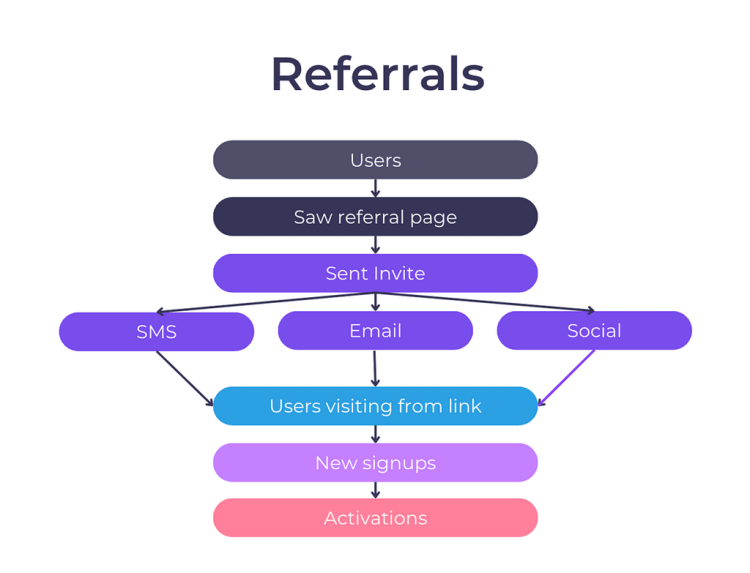
For example, if you have a ton of users, but none of them have gone to the referral page, it doesn’t matter how good your referral page is because no one is even getting there. Or if you have tons of users sending invites but aren’t getting any traffic from those links, maybe you need to tweak your referral messaging. The idea is to systematically review your user journey and find the highest impact areas.
Growth Marketing:
Growth marketing is a data-driven marketing approach that aims to acquire and retain customers, optimize conversions, and drive sustainable growth. It encompasses a range of strategies and channels, including paid advertising, search engine optimization (SEO), and social media marketing.
Paid
Paid advertising involves investing in targeted advertising campaigns across various platforms, such as search engines, social media, and display networks. By strategically allocating your budget and optimizing ad performance, you can drive relevant traffic to your website or app, increasing conversions and revenue. Some important paid terms are below.
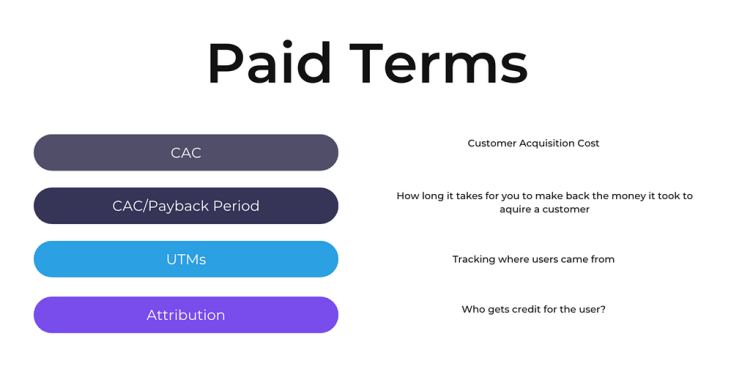
Depending on your product, I suggest staying out of the paid game as long as possible. If you don’t have good organic growth and good retention, you can spend tons of money before you know if your product is any good. This is the classic leaky bucket analogy where you don’t want to continue pouring water into a bucket if it’s all just coming out the bottom anyway.
That being said, the paid marketing world is vast, complex, and powerful.
SEO
For those who don’t know what SEO is, it stands for search engine optimization. It focuses on improving your website or app’s organic visibility in search engine results. By optimizing your website’s structure, content, and relevance to specific keywords, you can increase your chances of ranking higher in search results.
Higher rankings lead to increased organic traffic, creating sustainable growth opportunities. The main idea is that the highest intent traffic is those specifically looking to buy something, and your site showing up first means you’re likely the one they will convert with.
A small, maybe irrelevant note here is that I worry about the longevity of SEO with the advent of generative AI like chat GPT. SEO may become less powerful if search volume drops because people are using chatbots.
Social
Social media marketing leverages social platforms like Instagram, Twitter, and Tiktok to build brand awareness, engage with audiences, and drive website traffic. By creating content and fostering community interaction, you can reach and connect with your target audience on platforms they frequent, driving growth.
Social can be one of the most powerful tools in the modern startup’s arsenal. It isn’t easy to get right, but if you figure it out, it will be a low-cost, consistent driver of traffic. Look at Duolingo on Tiktok if you want inspiration.
Data Soapbox
I come from a data background. My first job out of college was a pure data role, which is primarily how I approach growth. But even taking that aside, I believe that it is nearly impossible to effectively use growth to scale your business unless you have good data/can analyze that data.
The core of growth is experimentation. You use hypothesis tests to run traditional AB experiments to determine if the change you made to a product or campaign made a positive impact (and how big that impact is).
To do that effectively, you need to be able to segment users, track their behavior, and analyze the results of your experiment. To do any of that, you need good data infrastructure. For this reason, I always suggest startups build out a data team (or at least have a dedicated data engineer) before investing in a growth team. Your future growth hires will thank you.
This is the first time I’ve written an article like this. Most of the time I write pie-in-the-sky musings on random topics, but this one is a bit more practical. If you want more of this type of content, let me know. And if there’s anything you want me to dive deeper into and I just might write an article about it.
If you enjoyed this post, follow me for more articles on startups and growth.
How to Fuel Your Startup’s Growth Engine was originally published in Entrepreneur's Handbook on Medium, where people are continuing the conversation by highlighting and responding to this story.
SOURCE: https://ift.tt/XSUnLpI https://ift.tt/3dbAaZ2
Discover more from The Veteran-Owned Business Blog
Subscribe to get the latest posts sent to your email.

You must be logged in to post a comment.